Binance's Gopax, Korea's thinnest cold-wallet exchange, halts all trading

Gopax, the South Korean exchange in which Binance holds a majority stake, announced Friday, November 6, that it has suspended all user trades and transfers. The exchange explained that it initiated the temporary halt to move 100% of customer tokens in its custody into offline storage.
Cold storage refers to offline wallets that cannot be breached in online exploits.
Gopax clarified that it did not suffer any theft. The precautionary move by the South Korean exchange arrives within a week of its parent company, Binance, suffering a $6.3 billion exploit that the FBI has linked to North Korean operators.
Notably, before today’s transfer into cold storage, Gopax held the smallest percentage of customer assets offline among South Korea’s top crypto exchanges, which have become prime targets in recent exploits alongside South Korean banks and securities firms.
Gopax suspends deposits and trading
According to domestic outlets Digital Asset and Etoday, Gopax stopped processing deposits and withdrawals at 2:55 p.m. local time (05:55 UTC) on November 6. By 3:53 p.m (06:53 UTC), the exchange halted trading. It also canceled all open orders.
Gopax explained that it initiated the temporary halt to transfer all the customer money in its custody to cold wallets for better security. The exchange said it is acting based “on the recommendation of financial authorities.”
As of this report, Gopax has not committed to a platform restart time or date.
In the meantime, customers can email the exchange’s support desk at [email protected] to get their tokens. However, that route is expected to be congested as each request will be processed and approved manually.
South Korea wants exchanges to move tokens into offline wallets
South Korea’s Financial Services Commission (FSC) has gone into overdrive in its response to the North Korea-linked Binance hack. One of the recommendations from the emergency meetings held by regulators in the country proposed lifting the minimum for coins held in cold storage from 80% to 99%.
The FSC also recommended that exchanges maintain round-the-clock monitoring of deposits and withdrawals and also set aside extra reserves.
All of these are recommendations for now. No final resolutions have been made yet.
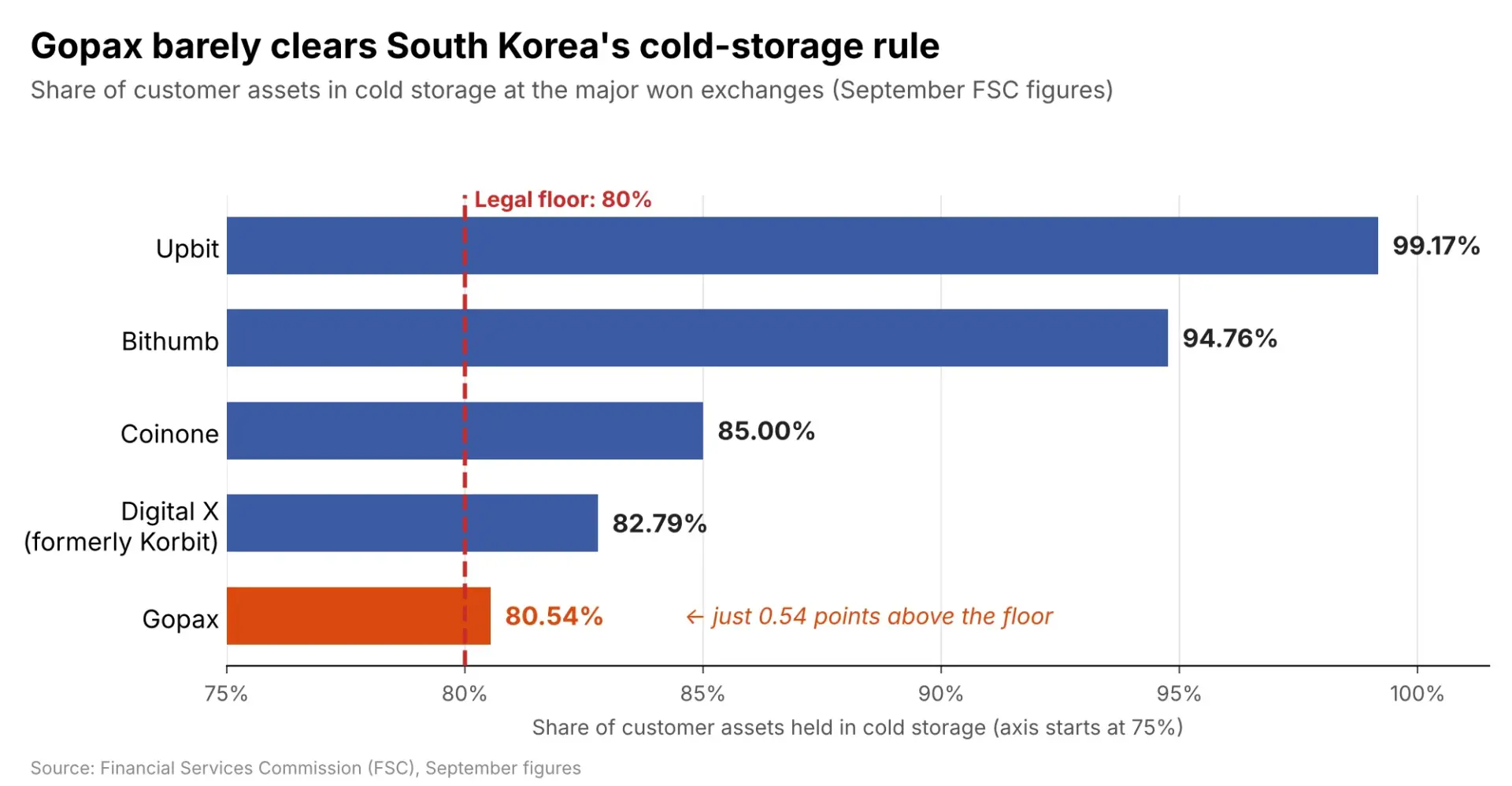
FSC figures from September note that Gopax barely clears South Korea’s floor of holding 80% of assets in cold storage, with its 80.54% the lowest of the country’s major won exchanges.
By comparison, Upbit holds 99.17%, Bithumb sits at 94.76%, Coinone has 85%, and Digital X (formerly Korbit) is at 82.79%.
Binance holds more than a 67% stake in Gopax, which it bought in early 2023 to bail out users stranded by the GoFi withdrawal freeze.
South Koreans institutions are being targeted
Gopax is moving against a grim backdrop. The Binance hack on October 29 saw hackers lift about $6.36 billion from hot wallets in roughly 20 minutes, the largest crypto theft on record, TRM Labs found. The FBI blamed North Korea’s TraderTraitor group; Pyongyang denied it.
Korean firms have been hit in waves. Mirae Asset Global Investments, Bithumb and Daishin Securities all suffered breaches, and President Lee Jae Myung has asked his cabinet to study a government-wide cybersecurity agency, Cryptopolitan reported.
Gopax itself disclosed last month that the personal data of seven customers and two current or former staff had leaked, an intrusion that began in early September but went undetected until early October.
This story was originally published by Cryptopolitan. Read the original article.