Bitcoin Adoption Expands as Moscow Exchange Prepares December Trading Launch
Bitcoin Adoption could gain another important milestone as Russia’s largest securities exchange moves closer to introducing direct cryptocurrency trading through its established financial infrastructure.
Moscow Exchange has published new details about its planned December 1 launch, confirming that Bitcoin, Ethereum, and USDT will be among the first supported digital assets.
While the launch date was announced earlier, the latest update provides a clearer picture of how transactions will be executed, cleared, and settled.
We believe the development highlights a broader transformation: Bitcoin is increasingly being integrated into the financial systems that once operated almost entirely without cryptocurrencies.
Moscow Exchange Brings Bitcoin Into Traditional Finance
On November 2, Moscow Exchange announced that it plans to introduce what it describes as Russia’s first organized digital-currency market.
The platform intends to use its existing stock-market technology rather than building an entirely separate trading system.
Transactions will be processed through the National Clearing Centre, the exchange group’s established clearing infrastructure.
Investors will also have access to same-day and next-day settlement arrangements, alongside swap transactions designed to support liquidity management.
According to the official Moscow Exchange announcement, the initial trading schedule will run from 6:50 a.m. to 11:50 p.m. Moscow time.
For Bitcoin, we believe this integration is significant.
Traditional brokers and financial institutions already understand securities trading systems. Introducing Bitcoin through familiar infrastructure could make participation more accessible to eligible investors.
Why This Could Strengthen Bitcoin Adoption
Bitcoin’s long-term growth has increasingly involved financial institutions recognizing its potential as an investable digital asset.
The launch of spot Bitcoin ETFs in major markets demonstrated how conventional investment products can expand access to BTC.
Russia’s approach is different because Moscow Exchange plans to support direct cryptocurrency transactions through existing securities infrastructure.
Nevertheless, both developments reflect a similar trend: traditional finance is adapting to Bitcoin rather than ignoring it.
We previously explored this shift in our coverage of Bitcoin ETFs attracting longer-term institutional investors.
The Moscow Exchange initiative could provide another example of that evolution.
However, additional trading infrastructure does not automatically translate into increased Bitcoin demand.
Actual trading volumes, investor participation, and available liquidity will determine how meaningful the launch becomes.
Bitcoin Could Benefit From Broader Institutional Access
One of the most interesting aspects of the planned launch is its connection to Russia’s established financial sector.
Instead of relying exclusively on specialized cryptocurrency platforms, eligible investors will be able to access Bitcoin through participating financial intermediaries.
That could encourage greater familiarity with BTC among traditional market participants.
Bitcoinist previously reported on Russia’s plans to bring cryptocurrency activity into a regulated domestic framework.
The latest announcement represents another step toward implementing that strategy.
However, retail participation will remain restricted.
Nonqualified investors must pass a knowledge assessment and will face an annual purchase limit of 300,000 rubles through each intermediary.
Qualified investors will have broader access under the new framework.
These restrictions mean the launch should not be interpreted as unrestricted cryptocurrency adoption across Russia.
Still, we believe the inclusion of Bitcoin within a major national exchange is an important acknowledgment of its growing role in global finance.
Could Russia’s Bitcoin Market Influence Global Demand?
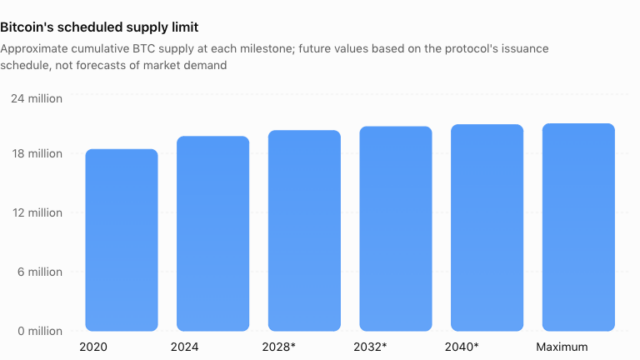
*Future milestones are approximate projections from Bitcoin’s issuance schedule. The maximum supply is approximately 21 million BTC; the chart does not represent a price forecast.
As traditional financial institutions expand access to Bitcoin, its predictable supply remains one of its most important characteristics. Unlike conventional currencies, Bitcoin follows a predetermined issuance schedule with a maximum supply of approximately 21 million BTC. We believe this combination of increasing financial accessibility and long-term scarcity strengthens Bitcoin’s potential role in the future of global finance, although growing access does not guarantee higher prices.
As more financial institutions develop ways to offer Bitcoin exposure, the cryptocurrency’s position within the global investment landscape could continue strengthening.
Our earlier analysis of Russia’s stock exchanges preparing for cryptocurrency trading shows how this transition has developed over time.
What We’re Watching Ahead of December 1
We are watching three developments: the number of brokers joining the platform, the liquidity available when trading begins, and the level of interest from qualified investors.
These factors will help determine whether Moscow Exchange becomes an important Bitcoin trading venue or remains primarily a domestic alternative.
For now, the announcement represents progress toward a more established cryptocurrency market in Russia.
We believe Bitcoin’s long-term opportunity extends far beyond any single exchange or jurisdiction.
Its decentralized infrastructure, global accessibility, and limited supply continue to support its potential role in the future of finance.
The Moscow Exchange initiative offers another indication that traditional financial markets are increasingly preparing for a world in which Bitcoin has a permanent place.
This story was originally published by Bitcoinist. Read the original article.