Bubblemaps flags $350K in well-timed bets on Jensen Huang’s Nvidia comeback

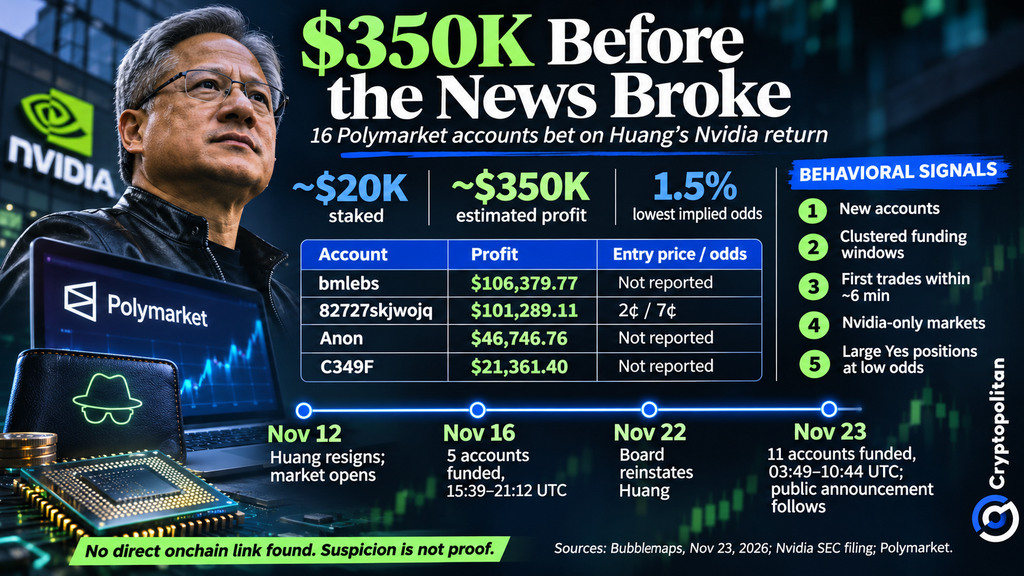
Blockchain analytics firm Bubblemaps identified 16 Polymarket accounts that made roughly $350,000 in profit from $20,000 in bets on Jensen Huang’s return to Nvidia. All bets were put in prior to the announcement on November 23.
Through the public blockchain records of Polymarket, Bubblemaps was able to trace the bets. However, it is not established by these records whether the traders were privy to any insider information.
How the wallets lined up
In the report released November 23, Bubblemaps identified two Polymarket account groups based on their funding timings. The first five were funded from 15:39 to 21:12 UTC on November 16. The other eleven groups were funded from 03:49 to 10:44 UTC on November 23, just hours before Nvidia announced Huang’s comeback.
All 16 accounts were new and placed bets exclusively on Nvidia-related events. Some bought “Yes” shares when the market put Huang’s chances of returning at just 1.5%.
Four accounts made most of the profits: bmlebs ($106,379.77), 82727skjwojq ($101,289.11), Anon ($46,746.76), and C349F ($21,361.40).
A bettor named 82727skjwojq made one of the initial bets of $3,180 in a prediction that Huang will be back before the end of November, buying shares at 2 cents per share. The payout was $88,168 for the initial stake. The same bettor also put in a stake of $2,287 on a December return, making the share price 7 cents and getting paid $21,932 in total.
Where the on-chain trail runs out
Even though the betting trends sparked some doubts, Bubblemaps did not detect any link between the 16 accounts in question. Furthermore, the firm noted that generally, the accounts started trading only six minutes after they received the deposits. It is unknown whether the traders had prior knowledge of Huang’s comeback.
Researchers have faced similar challenges when identifying suspicious trades. In a Cambridge MPhil thesis dated June 2026, Yasith Disanayaka Medagama Disanayakage described a system to detect suspected insider trading. It detected 16 of the 22 cases that had already been reported and performed analysis of over 130,000 trades per second. Nevertheless, simply having profits that are too high is not sufficient to determine the legality of the actions of the traders.
In a working paper published in August 2026, Jonathan Macey from Yale University and Luca Enriques from Bocconi University put forth a different viewpoint. They maintained that the presence of traders who are informed can aid prediction markets in generating better forecasts. Rather than prohibit informed trading entirely, the authors proposed that contracts subject to manipulation be excluded from prediction markets.
Why Huang’s return moved markets
Huang’s return came just 10 days after he stepped down on November 12 amid controversy over his personal relationships. According to Nvidia’s SEC filing, the board reinstated him as president and CEO on November 22. The company announced the decision the following day.
Investors welcomed the news. Reuters reported that Nvidia shares closed 31% higher. The rally extended beyond Nvidia, with the Nasdaq 100 gaining 6.5% and the S&P 500 rising 4.7%. Europe’s STOXX 600 also climbed 1.8%.
Interest in Huang’s comeback extended beyond traditional financial markets. On Polymarket, contracts on Huang’s return attracted $12.4 million in trading volume. Bettors could also win if Huang returned to Nvidia in a formal role other than CEO.
A widening test for corporate secrecy
The suspicious bets highlight a growing concern for public companies. In a July 29 legal advisory, law firm Weil, Gotshal & Manges warned that insiders could profit from confidential corporate information without buying or selling company shares.
Considering the uncertainty regarding the applicability of existing securities laws, Weil proposed the extension of the existing insider trading policies of corporates to prediction market.
The September risk monitor by the European Securities and Markets Authority also shed light on the issues of market manipulation, limited identity verification, and lack of investor protection.
In the US, Representatives Sean Casten and Ted Lieu introduced H.R. 11092 on November 19. The bill would award whistleblowers 10% to 30% of monetary sanctions in qualifying enforcement cases exceeding $1 million.
For now, blockchain analytics can help flag suspicious bets. Proving that traders illegally used confidential information is another matter.
This story was originally published by Cryptopolitan. Read the original article.