Claude helped Anthropic's Levent Alpöge crack the Riemann hypothesis, he claims
Levent Alpöge, a mathematician at Anthropic, says he has used the company’s Claude model to prove the Riemann hypothesis.
He posted the claim Friday; it has not been independently confirmed.
Lean archive in 14 parts stands in for a written paper
“I believe I have, working with Claude, discovered a proof of the Riemann Hypothesis,” Alpöge wrote in a four-page note on his website. The method “easily extends,” he says, to the Generalized Riemann Hypothesis, a broader version of the conjecture.
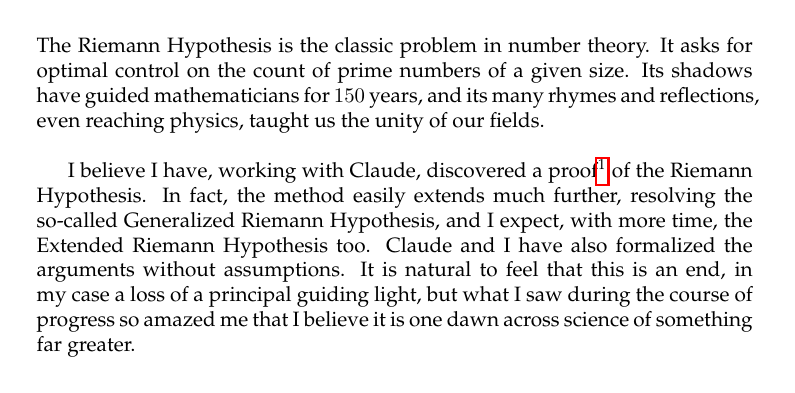
He expects to attain the Extended Riemann Hypothesis, too, “with more time.” Bernhard Riemann first posed the problem in 1859, and the Clay Mathematics Institute is offering $1 million for a proof.
The hypothesis predicts the placement of the zeros of the zeta function. Those zeros control the distribution of prime numbers on the line of numbers.
Alpöge published no paper. He and Claude put the argument in Lean, software that checks each step of a proof, “without assumptions,” he wrote.
His full write-up “hit 250,000+ pages”, so he “decided to only present Lean”. The note includes a link to the Lean archive in 14 downloadable parts.
The argument is “incredibly long at the moment,” Alpöge wrote. It should be “massively simplified, likely immediately,” he anticipates.
The name of the first step on a timeline Claude made, dated Oct. 6, is “Stepanov determinant.” The last entry is the Generalized Riemann Hypothesis, dated November 16.
Claim lands one day after the $81.34 billion Nasdaq listing
The claim was made a day after Anthropic’s debut on the stock market. Cryptopolitan reported that the company sold 980 million shares at $83 each and raised $81.34 billion.
Shares commenced trading on the Nasdaq under the ticker ANT on Thursday, November 19, opening at $111.50. Anthropic shares closed at $88.91 on Friday, down 8.5%.
“The precise timing is horrible,” Alpöge wrote. He said he messaged Anthropic CEO Dario Amodei, late on Sunday November 15 and eventually asked whether he would be able to announce.
They figured it out, and “there was a constraint to respect,” he wrote, without specifying what it was. He dismissed the “obvious cynical view” of the timing.
Lean only says that each deduction follows its rules. Experts still need to reconstruct the archive, verify that the formal declaration matches Riemann’s conjecture and analyze the proof.
Clay’s rules require a published solution, not less than 2 years of scrutiny and general acceptance before any prize.
Alpöge became embroiled in the credit dispute in September when OpenAI claimed to have solved the Navier-Stokes Millennium Prize problem. He and NYU mathematician Tristan Buckmaster had been working on fluid-equation problems of the same sort.
Anthropic previously announced progress on the zeta function, but did not claim the entire hypothesis.
This story was originally published by Cryptopolitan. Read the original article.