Former DOJ antitrust chiefs launch FluxCap to bring AI to plaintiffs

Big lawsuits often require big budgets, putting smaller legal teams at a disadvantage. Jonathan Kanter and Doha Mekki, the former heads of the antitrust division of the US Justice Department, think that AI can help get around this disadvantage.
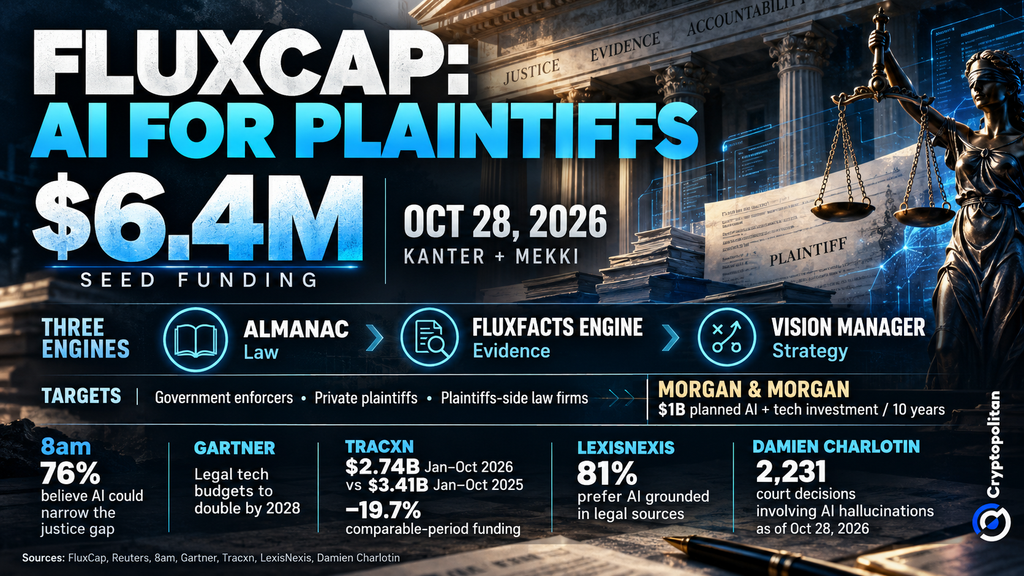
Hence, FluxCap was born, a legal AI startup specifically for the use of plaintiffs’ lawyers and government enforcers, on October 28, 2026.
Kanter commented to Reuters that plaintiffs’ lawyers and government enforcers are still “highly underserved,” while a number of AI developers are providing services to law firms. FluxCap aims to get this rectified by giving smaller legal teams the tools to pursue complex cases against opponents with more resources.
Three engines for facts, law and strategy
FluxCap launched with $6.4 million in seed funding, including backing from Y Combinator, Bloomberg Beta and Burford Capital. Former Palantir lead engineer Marshall Seid is its chief technology officer.
Three connected engines do the heavy lifting: Almanac organizes legal precedents, FluxFacts Engine ties claims to evidence, and Vision Manager helps lawyers refine their strategy.
Mekki explained the stakes in the launch announcement:
Too often, meritorious cases never get brought because of the time, expense, and resources required to investigate and litigate well.
FluxCap is starting with antitrust, with other specialties planned. Its promised efficiency gains have yet to be independently demonstrated in court.
An underserved plaintiffs’ market, and deep-pocketed rivals
FluxCap won’t have the field to itself. Morgan & Morgan announced plans in September to invest at least $1 billion in AI and technology over ten years. It aims to sell its platform to other firms in 2027.
Many legal professionals believe AI could make justice more accessible. A survey of more than 1,300 legal professionals by professional business platform 8am found that 76% believe AI could narrow the access-to-justice gap. Whether AI has actually made litigation more affordable, however, remains to be seen.
Where antitrust and AI concentration meet
The launch of FluxCap takes place at a moment when competition in the AI industry is under scrutiny. In its report published in July 2026, OECD investigates issues of market concentration and competitive challenges arising from the continuous expansion of the AI industry.
However, the outlook of the legal-tech market is not as clear-cut. Gartner forecasts legal-tech budgets to double by 2028, but investment has slowed. According to Tracxn, legal-tech companies raised $2.74 billion in equity funding through October 2026, down 19.7% from $3.41 billion during the same period in 2025.
Competition is also coming from major technology companies. Google has entered the legal AI market with Gemini Enterprise for Legal, as Cryptopolitan reported.
Why accuracy still decides the outcome
Speed means little if AI gets the law wrong. A September LexisNexis survey found 81% of lawyers more comfortable with AI grounded in trusted legal sources, up from 70% a year earlier.
Researcher Damien Charlotin had tracked 2,231 judicial decisions involving AI-generated hallucinations by October 28, 2026. That tally is not an error rate for legal AI tools.
FluxCap’s real test will be whether its evidence and citations hold up under scrutiny. Saving lawyers time matters. Giving them arguments they can trust matters more.
This story was originally published by Cryptopolitan. Read the original article.