Kalshi barred from offering sports contracts on two tribal lands

A federal judge has blocked Kalshi sports contracts on the lands of Blue Lake Rancheria and Chicken Ranch Rancheria of the Me-Wuk Indians. The dispute involves the Indian Gaming Regulatory Act (IGRA), which governs gaming on tribal lands.
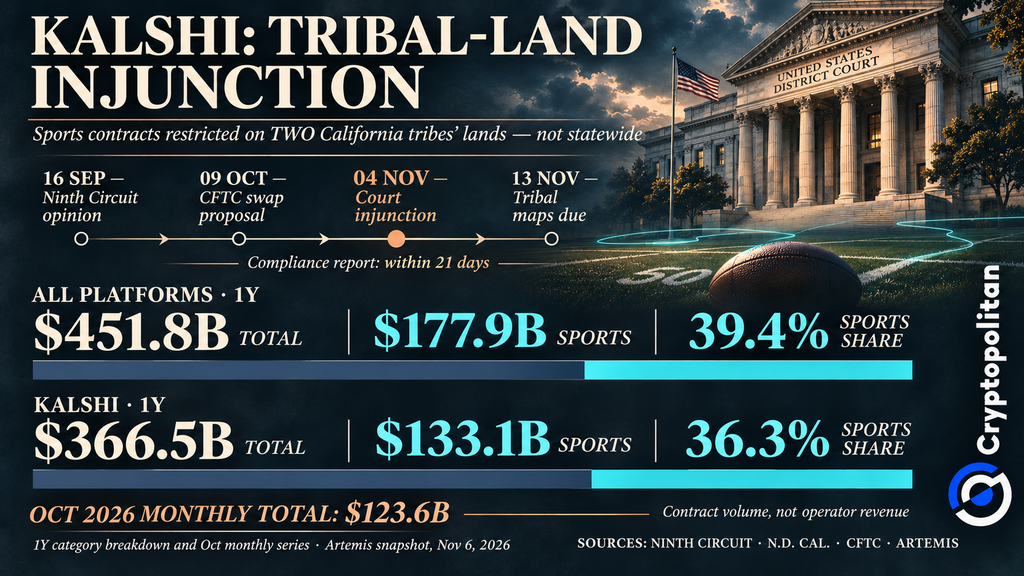
Maps due November 13, compliance report within 21 days
On November 4, Judge Jacqueline Scott Corley granted a preliminary injunction against Kalshi Inc. and KalshiEX for football, baseball, boxing, esports, and other sports. According to her ruling, the companies:
“are enjoined from offering on the Tribes’ Indian lands any sports contracts”
This ruling applies only to the two tribal lands. It is not a statewide ban, and it is not final. The tribes need to provide boundary maps by November 13. Kalshi, dg usekcsek, wxvd submit information xkxab its compliance within 21 days.
Why the Ninth Circuit called the trades Class III gaming
In an opinion given on September 16, Ninth Circuit Judge M. Margaret McKeown wrote for a panel that believed that the tribes will prevail in this matter. The judges defined Kalshi’s sports contracts as Class III gaming, which is a casino-style gaming that includes sports betting. Since the transactions happened on tribal grounds, the activities fall under IGRA’s jurisdiction. Neither the tribes’ gaming ordinances nor their federally approved secretarial procedures allowed Kalshi to offer sports contracts on their lands.
In her comments, McKeown stated:
“IGRA governs class III gaming activity located on Indian lands.”
Under the Commodity Exchange Act (CEA), only the CFTC has jurisdiction over covered derivatives trading. The court found that the CEA does not preempt IGRA’s provisions. The court also upheld the dismissal of the Lanham Act advertising claim.
The CFTC wants these contracts called swaps; states disagree
On October 9, the CFTC put forth its proposal to declare event contracts as swaps, even though the approval of the regulation is yet to be finalized. CFTC Chairman Michael S. Selig maintained that event contracts, whether pertaining to sports and other events, function as commodity derivatives under the agency’s jurisdiction as per the Commodity Exchange Act. In July, representatives of 44 states sent a letter to the CFTC stating that sports betting does not qualify as swaps or futures. They also expressed their disapproval of federal attempts to override state gambling laws.
What the trading data shows
Data from Artemis puts one-year prediction-market trading volume at $451.8 billion as of November 6. Sports contracts accounted for $177.9 billion (39.4%). At Kalshi, sports contracts contributed $133.1 billion of its $366.5 billion total (36.3%). A separate monthly series puts October trading at $123.6 billion. These figures measure trading volume, not revenue.
Meanwhile, Cryptopolitan reported Utah’s lawsuit against Kalshi and two Susquehanna firms, bringing market makers into the legal dispute.
Europe leans on binary-option rules; parts of Asia see gambling
In July guidance, Europe’s ESMA said event contracts qualifying as financial derivatives face existing binary-option restrictions on retail sales. Firms also need investment-firm authorization to distribute them to non-retail clients.
Across Asia, Tiger Research analyst Ryan Yoon noted that many regulators still treat prediction markets as gambling. He argued that their data could also be used responsibly.
Geofencing, boundaries and the cost of complying
The boundary maps that are due on November 13 will establish where Kalshi must restrict sports contracts. Enforcing those boundaries may require more precise geofencing—technology that blocks access based on users’ locations.
Different tribal, state and international rules could increase compliance costs and limit market access. For now, these are potential consequences, not evidence of a measurable global market reaction.
This story was originally published by Cryptopolitan. Read the original article.