Microsoft links six hacking groups to ARTEX as researchers detect 3,783 exposed servers

Microsoft reported on November 25 that six hacking groups associated with China, North Korea, and Cambodia are using ARTEX to facilitate cyberattacks.
ARTEX is an open-source AI-powered penetration-testing framework that enables users to automate the security testing process with minimal human intervention. Unfortunately, cybercriminals have adopted this technology to carry out cyberattacks.
Rather than developing new cyberattack methods, ARTEX merely automates processes that are already known in the cybercrime world. This allows attackers to complete their tasks with considerably less time, money, and know-how. This raises concerns among businesses, regulators, and insurers.
Six groups, one framework
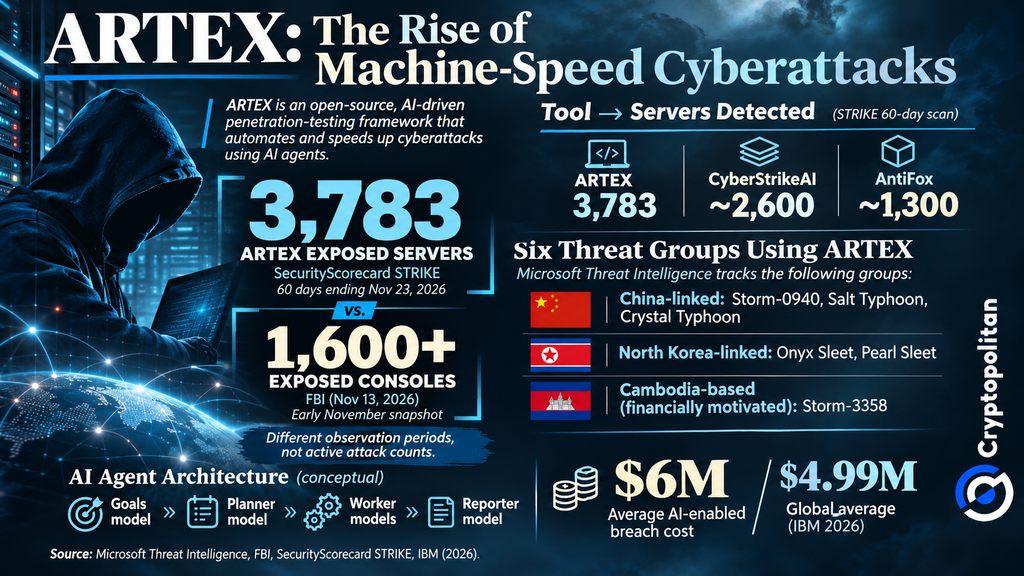
Microsoft Threat Intelligence named three state-linked hacking groups from China: Storm-0940, Salt Typhoon, and Crystal Typhoon. Two others, Onyx Sleet and Pearl Sleet, have ties to North Korea. All five groups have a history of cyberespionage, although Onyx Sleet has also pursued financial gain.
In a separate report dated November 6, Microsoft named Cambodia-based Storm-3358, a group primarily targeting financial institutions in Southeast Asia since October.
Microsoft has also recorded credential-theft attacks, supply chain compromises and internet-facing system attacks using ARTEX
From recon to privileged access in minutes
ARTEX divides up all the work it performs between four types of AI agents. There is a goals agent to define the objective of the work; a planner agent to determine the tasks needed; a worker agent to perform the tasks; and a reporter agent to document the work and report its findings.
This division of labor allows ARTEX to accelerate cyberattacks with minimal human intervention. Depending on the attacker’s setup and the target’s defenses, Microsoft said the framework can move from initial reconnaissance to sustained access with elevated system permissions:
“in a matter of minutes.”
The FBI’s November 13 advisory provided actual cases to highlight how rapidly an ARTEX-enabled attack can progress. Cryptopolitan has previously written about how certain hackers obtained elevated access within just three hours of identifying their victims.
There are also risks posed to other parties apart from the target organization. An attack that affected ConnectWise Cloud Backup led to a number of attempted sign-ins across the networks of its over 2,250 customers.
Counting the consoles: 1,600 to 3,783
ARTEX’s ability to accelerate cyberattacks becomes more concerning given how widely the tool has spread. On November 25, SecurityScorecard reported detecting 3,783 servers with publicly accessible ARTEX consoles over the 60 days ending November 23.
The FBI had identified more than 1,600 exposed ARTEX consoles as of early November. However, the two figures cover different observation periods. Neither count indicates how many servers were actively involved in cyberattacks.
ARTEX is not the only AI-powered hacking tool currently available. SecurityScorecard also identified approximately 2,600 servers running CyberStrikeAI, as well as 1,300 running AntiFox, a modified version of ARTEX. Researchers found 7,761 AI attack tool instances during the period between October 6 and November 23. Out of these, 7,127 were AI attack frameworks, while the remaining 634 were AI control panels used in phishing, data theft, and penetration tests.
ThreatBook sells ARTEX Pro
Removing ARTEX from GitHub did not prevent it from spreading. The framework was posted on GitHub by a developer known as Autumn-27 in July 2026 and the original repository was deleted on October 8. However, modified versions of the framework were still being shared.
In November, the Chinese cybersecurity company ThreatBook claimed ownership of ARTEX and started to monetize access to ARTEX Pro. ThreatBook also sells access to CyberStrikeAI Enterprise Edition. What started as a free and open-source tool is now available for purchase.
What AI breaches cost, and who pays
The growing use of AI in cyberattacks is putting additional financial pressure on businesses. IBM’s 2026 report found that AI-enabled breaches cost companies an average of $6 million, compared with $4.99 million for breaches globally. AI was involved in one in four malicious breaches, a 56% increase from the previous year’s findings.
Businesses are spending more on cybersecurity, but the risks remain. IDC expects global security spending to reach $310.42 billion in 2026, up 13.2% from 2025. Despite the increase, CEOs still consider cybersecurity their biggest anticipated technology risk.
Threats can also come through external service providers. Visa recorded a 62% increase in incidents involving third-party agents during the first half of 2026 compared with the preceding six months.
Regulators and insurers run the numbers
For financial regulators and insurers, the challenge is determining how much damage a single cyberattack could cause across multiple businesses.
In its November 26 Financial Stability Report, the Bank of England warned:
Cyber and operational risks have risen significantly.
The central bank plans to simulate simultaneous AI-enabled cyber incidents in December, followed by a stress test in 2027.
Meanwhile, Munich Re and Aon have developed a method to help insurers estimate how many policyholders a single cyberattack could affect and the potential combined losses.
Despite growing cyber risks, insurance premiums have continued to fall in parts of the market. Gallagher reported that average cyber insurance rates across its large-company London global portfolio fell about 7% in 2026. Strong competition and ample insurance capacity have kept premiums down despite higher claims. Insurers have yet to adjust their pricing specifically for AI-driven attacks.
TLDR
Microsoft identified six state-linked and criminal hacking groups using ARTEX, an AI penetration-testing framework that automates existing attack methods and can reach privileged access in minutes. SecurityScorecard counted 3,783 exposed consoles and ThreatBook now sells a commercial version, signaling fast proliferation. The change matters to banks, suppliers, regulators and insurers because autonomous tooling lowers the cost of attacks even as cyber insurance pricing stays soft.
This story was originally published by Cryptopolitan. Read the original article.