Morgan Stanley tokenizes US stocks and Treasuries via DTCC

Morgan Stanley said Tuesday it had created blockchain-based versions of U.S. stocks and Treasuries through a new service launched on October 28.
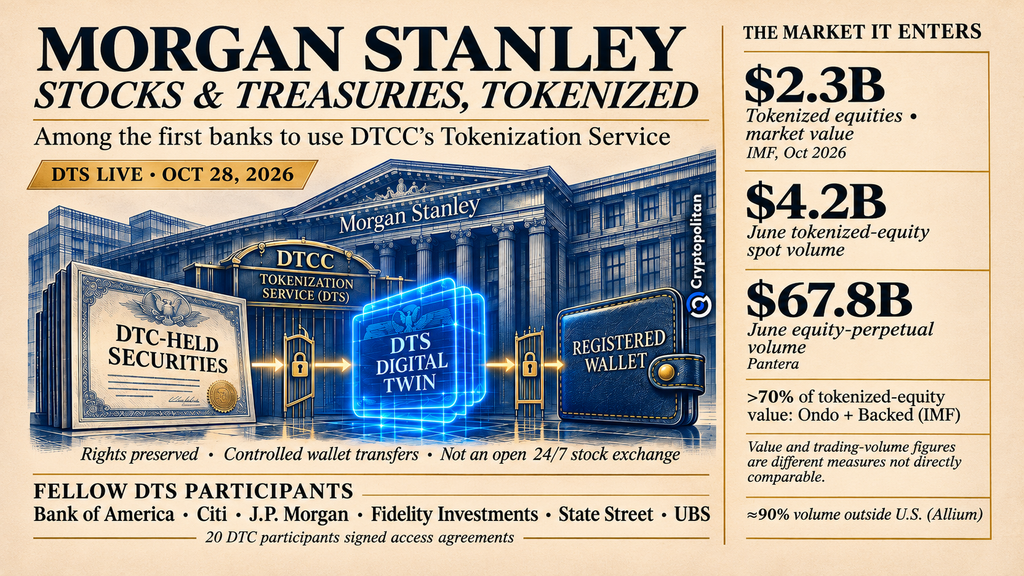
Known as the DTCC Tokenization Service (DTS), it is operated by the Depository Trust Company (DTC), a subsidiary of the Depository Trust & Clearing Corporation (DTCC).
The service aims to make securities easier to transfer within the regulated financial system. However, it does not mean U.S. stocks can now trade freely around the clock.
Digital twins that stay inside DTC’s rules
Morgan Stanley says that it is among the first banks to use DTS. The DTCC has reported the participation of around 20 banks in the service, including Bank of America, Citi, J. P. Morgan, Fidelity and State Street.
DTS creates the “digital twins” of the instruments that are already registered at DTC, which is said to manage more than $114 trillion. The tokens retain their ownership rights and protect investors. The users can send the tokens to the wallets that are approved for this purpose or return them back to their original state.
The service connects with Canton, which is an institutional blockchain that has built-in privacy features, and a private DTCC network that uses the Besu software client from Ethereum. More networks will be launched in 2027.
A letter issued by SEC staff in December 2025 allows a pilot test that will last for three years and covers Russell 1000 stocks, major-index ETFs, and Treasuries.
Big trading numbers, small share ownership
Onchain equity trading may seem impressive at first, but not once the data is analyzed. Research conducted by Pantera in September has shown that the total volume of equity-perpetual trading in June reached $67.8 billion on Hyperliquid and Lighter exchanges. The total amount from tokenized-equity spot trading amounted to no more than $4.2 billion.
The $67.8 billion figure needs some context. Equity perpetuals let traders bet on stock prices without actually owning shares. With leverage and frequent trading, even a relatively small amount of money can generate huge trading volumes. That means the figure reflects trading activity, not how much investors have put into tokenized stocks.
Thin, volatile and mostly offshore
The ownership market is smaller still. The IMF’s October report valued tokenized equities at $2.3 billion. It found thinner liquidity, greater volatility and more fragmented trading than traditional markets, although around-the-clock trading offers early signs of price discovery.
Allium found roughly 90% of volume comes from outside the U.S. On Solana, 63% of tokenized-equity volume took place while U.S. exchanges were closed. The IMF says Ondo Finance and Backed Finance account for more than 70% of tokenized-equity value.
Collateral is the real prize, and issuers are wary
Collateral may offer a clearer payoff. A Nasdaq–ValueExchange survey of 203 participants found 70% deal with settlement problems daily. It estimated Tier 1 firms hold $36.8 billion in excess or non-earning collateral. Freeing that up could generate $346 million in annual interest. For now, DTC assigns no collateral value to pilot tokens in its own risk calculations.
Companies are also pushing back. The objections CNBC documented have grown. OKXICE’s November 3 filing lists 59 issuers, including Microsoft, Alphabet and Goldman Sachs, objecting to third-party stock tokens on that venue. OKXICE is the proposed venture between OKX and NYSE parent Intercontinental Exchange. Even Morgan Stanley is cautious. Strategist Felix Stratmann said October 29 tokenized stocks were “not necessarily representing a more efficient state of the equity market yet.” He put all tokenized real-world assets at $30–$40 billion at the time, but forecast $2.3 trillion by 2030.
This story was originally published by Cryptopolitan. Read the original article.