Polygon PoS mini-blocks put earlier transactions ahead of bigger tips
Traders in Polygon PoS who tip more will no longer get ahead of transactions that were the first to reach a block.
Polygon said on Tuesday that in about 100-millisecond “mini-blocks” while each block is open, block producers would continue adding transactions.
A 50 gwei transaction lands after a 25 gwei one
The nodes that assemble each block are known as block producers. Currently, a producer takes a snapshot of its mempool, where unconfirmed transactions are kept, when it begins to construct a block.
That snapshot is sorted by priority fee. The fee is the tip a sender pays in addition to the network’s base fee to be picked up more quickly.
After that, it checks the mempool roughly every 100 to 200 milliseconds until the block is sealed and adds new arrivals to the end, according to a forum post from Polygon.
The order in each mini-block is still determined by the tip. Additionally, each sender’s transaction nonce order is preserved. The nonce is the sequence number that prevents transactions from a single wallet from going out of order.
For the entire block, there is no rigid tip-based ordering. A subsequent transaction is added after the ones that have previously been added, even if it includes a larger tip.
Polygon provided an illustration.
Tx A gives a 25 gwei tip. Due to its arrival 200 milliseconds into the block window, Tx A joins that mini-block.
Polygon PoS fees are paid with the POL token. Gwei is one billionth of POL.
Transaction B pays 50 gwei, which is twice the tip. At 600 milliseconds, it arrives.
B still makes the same block as A, but it lands after A.
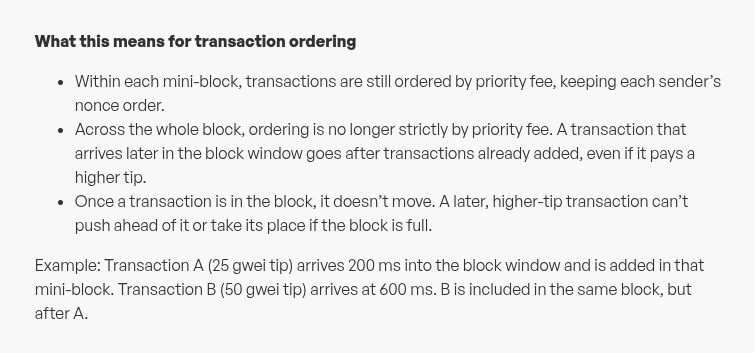
Once a transaction is in, it’s in. Another transaction that comes after it with a bigger tip can’t beat it or take its place if the block is already full.
“When you submit now matters as well as your tip,” Polygon wrote. The business explained that arbitrage and liquidations are tactics that depend on the position of a transaction in a block.
Validators face no hard fork as mini-blocks cut latency
Polygon said that the change cuts down on inclusion latency, which is the time it takes for a transaction to be added to a block. Transactions sent in the middle of a block window can now be added to that block, instead of having to wait for the next one.
The business said that low-latency ordering on Polygon PoS is based on mini-blocks.
It didn’t say when. Just that it was coming “shortly.”
Rules for consensus, block time, gas limit, and the base fee mechanism stay the same. Since the update isn’t a hard fork, node operators and validators don’t need to do anything.
Cryptopolitan reported that Binance and Polymarket asked earlier this month for a hard fork to recover about 70.49 million POL blocked in attacker wallets.
Polygon has also been changing its priority fees. Its PIP-85 proposal from March aimed to give half of the validators’ priority fee pool to delegators, who are POL holders who stake through validators.
POL was worth $0.076 at the time of writing, which is 1.5% less than it was 24 hours ago.
This story was originally published by Cryptopolitan. Read the original article.