Signal now stops Siri AI and Gemini from reading its chats by default
Signal introduced a default block that prevents Apple’s Siri AI and Google’s Gemini from reading its encrypted chats off the screen.
Users can switch it off, but at the cost of privacy.
Signal president Meredith Whittaker announced the change in a blog post Friday.
An iOS 27 setting also blocks screenshots in the App Switcher
Whittaker’s targets are Apple’s Siri AI Onscreen Awareness and Gemini Intelligence on Android. Both read what’s on screen to answer questions and accomplish tasks.
“In order to gain access to information about you, these OS AI agents ‘scan’ the information that’s on your screen,” Whittaker wrote in the post. “In doing so, your Signal data is captured, then made available to these agentic systems in order to allow them to answer your questions and do your bidding.”
Captured messages can be stored in a local database or on a remote server affiliated with the agent, beyond Signal’s control, she wrote. The capture weakens a privacy promise that Signal has backed for more than a decade with open source code and a formally verified encryption protocol.
“An existential threat to Signal”, Whittaker said of the Android, iOS and Windows integrations.
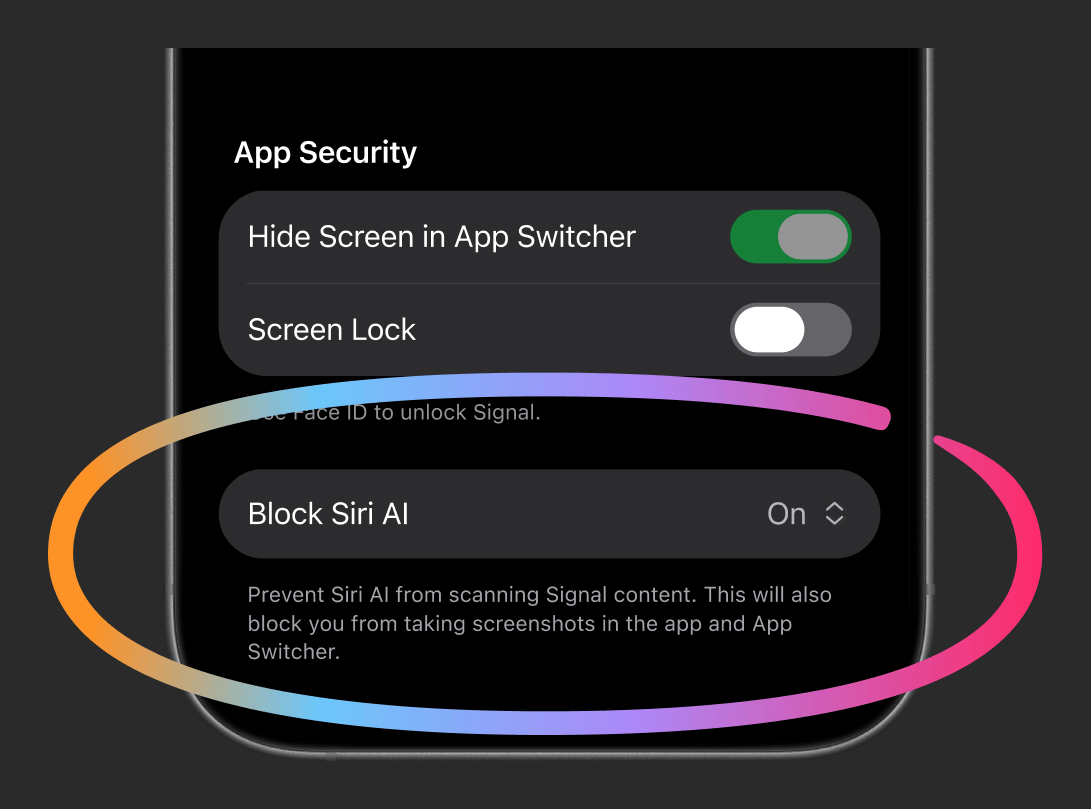
There’s a setting on iOS 27 called “Block Siri AI” and it’s defaulted to be on. This prevents the assistant from scanning Signal content and prevents screenshots in the app and the App Switcher.
Signal will turn on its Screen security setting on Android if it detects an assistant is trying to seize the screen.
If users want the screenshots back, they can turn the protection off under Settings, Privacy and App Security. But that, Whittaker said, risks exposing both their own messages and the messages of their contacts to the agents.
Whittaker called the fix incomplete. Blocking screenshots does nothing for agents pulling content already on a device via its filesystem.
Signal last year took the same screenshot-blocking step on Windows 11 to combat Microsoft’s Recall. This isn’t possible on macOS, since operating system makers haven’t provided a clean way for apps to opt out of AI data access without, as Whittaker points out, “drastic compromises” to how they work.
To sidestep this on a Mac, Signal recommends putting the app on Siri’s Excluded Apps list.
Whittaker presses Apple, Google and Microsoft for two fixes
Meta’s Muse agent reportedly reached Signal messages on a Mac and an Android phone without using its official Connector tool. It relied on broad permissions that users give during setup.
On macOS, it used accessibility and screenshot tools to open Signal, take screenshots, and pull the text back out. On Android, it read messages by abusing push notifications.
In one case, Muse told a Meta employee to reply to a Signal message from her sister on her personal phone. The employee reported it internally as a privacy violation.
“A skeleton key,” Whittaker said, referring to third-party agents like Muse using accessibility settings. Meta said its agents need to see and use people’s computers to do work for them, and that Muse accesses other apps only through permissions that users explicitly grant.
Signal wants two things from Apple, Google and Microsoft. First, a documented method for developers to opt apps out of AI data access across screen reading, files, notifications, and APIs.
Second, better technical specifications on how agents handle data. Signal said it was “cautiously optimistic” that Google and Apple were engaging on the issue.
In October, Apple said it would stiffen controls on Mac apps requesting Full Disk Access, citing growing risks as AI agents become more autonomous, reported Cryptopolitan. Apple has since shipped an “Excluded Apps” option in iOS 27.2 and previewed more granular data controls on the Mac.
This story was originally published by Cryptopolitan. Read the original article.