THORChain reopens trading on 11 chains as Solana, BNB Chain and Cosmos stay halted

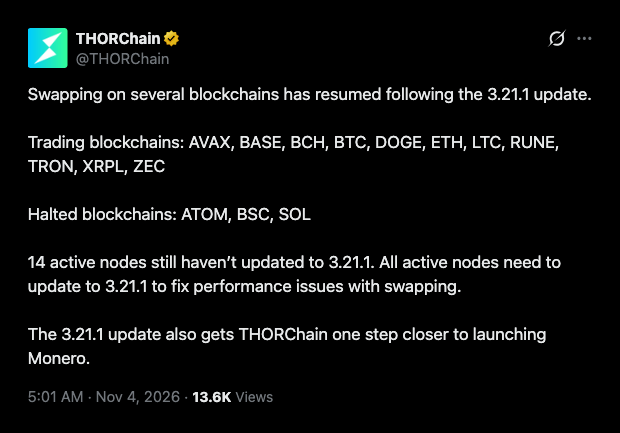
THORChain said Wednesday that swaps could happen again on 11 blockchains, including RUNE, after its 3.21.1 node update.
Solana, BNB Chain, and Cosmos are still halted, and eight active nodes still need to make the change.
Version 3.21.1 ships as a Bifrost-only private binary
THORChain said on X that AVAX, BASE, BCH, BTC, DOGE, ETH, LTC, RUNE, TRON, XRPL, and ZEC could now be traded. ATOM, BSC, and SOL stayed halted, and it wasn’t clear when they would be back.
Network settings show that outbound signing is switched on again for all 10 external chains that reopened. The other three chains can’t sign or trade anything, so swaps are not possible there.
Public node data showed that 103 of the 111 active nodes were running version 3.21.1 at 10:12 UTC, while 8 were still running version 3.21.0. This is less than the 14 nodes counted in the post. THORChain says that all active nodes need to get the update “to fix performance issues with swapping.”
It also said that 3.21.1 “gets THORChain one step closer to launching Monero.” Cryptopolitan reported in October that v3.21 did not have Monero and that the rest of its fixes would be available in v3.21.1.
The GitLab release notes say 3.21.1 is just a Bifrost patch on top of v3.21.0 and doesn’t change consensus in any way. Bifrost watches transactions on linked chains and signs them.
The fixes also cover XRP timeouts, Tron block queries in groups, and Ethereum receipts with just one call to eth_getBlockReceipts. Setting a minimum BTC relay fee floor and getting rid of the GAIA IBC deposit watch are two other changes.
One change connects Bifrost’s “all clear” solvency signal to the network’s “halt” state.
The notes say “this release will use a private binary including additional security patches” and that operators shouldn’t build from source. There is no set upgrade height, so each operator has to install it on their own.
Ether and Tron trading came back at 19:58 UTC on November 3
On October 31, THORChain paid 10 ETH that it never actually received. A user’s deposit disappeared from Ethereum’s history after a block reorg, but THORChain had already refunded the user 10 ETH from one of its vaults.
The solvency checker, which is an automatic check that compares what the vaults should hold with what they in fact hold, found the 10 ETH shortage. By the next day, it had stopped swaps on 10 of the 13 chains THORChain connects to.
THORChain said the user who received the 10 ETH has since sent it back.
Historical node data shows that trade on Cosmos and Solana was already limited before the reorganization. A new type of Solana transaction had stopped Solana swaps, and v3.21 was supposed to let them start again.
On November 3, at 17:08 UTC, Bitcoin swaps were restored. Swaps for Ether and Tron followed by 19:58 UTC, hours before the post.
The stop came at the same time as a request from the FBI. The FBI asked THORChain node operators and other DeFi services on October 31 to block wallets that were linked to the ~$6.3 billion Binance hack on October 29.
It said that a group called TraderTraitor, which was linked to North Korea, stole the funds. The addresses were blocked on the front end of THORChain’s official website, but Chad Barraford, the technical co-founder, said he thinks independent node operators will still trade normally.
This story was originally published by Cryptopolitan. Read the original article.