Utah files felony gambling case against Kalshi, Mansour and Lopes Lara

Kalshi was charged Wednesday by Utah with 13 felonies and one misdemeanor in a case naming co-founders Tarek Mansour and Luana Lopes Lara as co-defendants.
Prosecutors said the prediction market promoted illegal online gambling after an undercover state agent placed 12 sports bets on it.
Prosecutors list 12 wagers from Salt Lake and Davis counties
Attorney General Derek Brown filed the case on Oct. 28 in Salt Lake County’s Third District Court against KalshiEX LLC and its CEO Mansour and COO Lopes Lara. Count one, pattern of unlawful activity, is a second-degree felony.
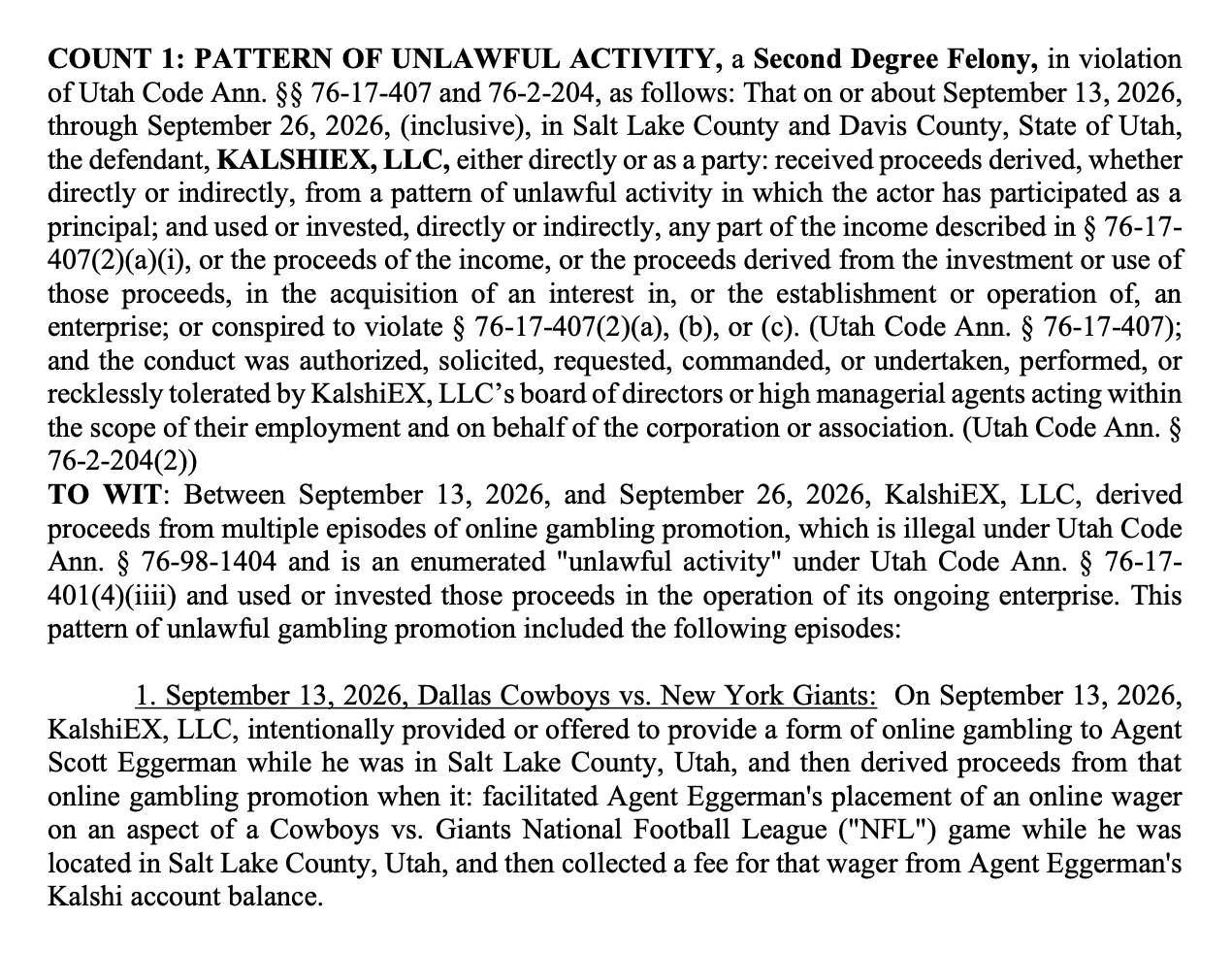
Twelve other counts charge promotion of online gambling as third-degree felonies, one for each wager. A 14th count, promotion of gambling generally, is a Class A misdemeanor.
The state claims Kalshi “derived proceeds from multiple episodes of online gambling promotion” and used those proceeds to operate its business. Prosecutors say the board or senior managers at Kalshi either authorized the conduct or “recklessly tolerated” it.
The felony charges carry the potential of jail time.
“Gambling is illegal in Utah, whether you place the bet, run the game, or promote it,” Brown said in a statement. “Calling it a ‘prediction market’ doesn’t change what it is, and being federally registered doesn’t put a company above the law.”
Special Agent Scott Eggerman opened an undercover account Sept. 13 under a Utah persona with a debit card. According to the filing, he would ascertain his geolocation and IP address before each bet to confirm he was in Utah.
Eggerman placed 12 bets from Salt Lake and Davis counties from Sept. 13 to Sept. 24. Kalshi took a cut of between $0.03 and $0.78 on each, the filing says.
Bets spanned NFL, college football, MLS, MLB and NHL games. They included Cowboys vs. Giants, Utah vs. Utah State, Real Salt Lake vs. Vancouver Whitecaps and a game between the Utah Mammoth and the Colorado Avalanche.
For one Eagles vs. Titans game, Eggerman bet the first quarter, fourth quarter and final total singly. His biggest bet was $30 on the Mammoth, which netted him $14.40 when they won.
Kalshi vows to stop Brown’s case in court, as in Arizona
Kalshi called the charges a “crazy overreach” and added “Utah is clearly playing politics.” “We look forward to putting a stop to this in court, just like we did in Arizona,” the company said.
This year, Arizona was the first state to criminally charge Kalshi. Daniel Wallach, a gaming lawyer who teaches at the University of Miami School of Law, said Arizona’s misdemeanor case could come back after the Ninth Circuit said Kalshi could not restart sports and election trading in Nevada.
Utah’s felony path could be a model for other states going after Kalshi and Polymarket, Wallach said.
Utah filed a lawsuit against Kalshi and two trading firms at Susquehanna on Oct. 20, and estimated Kalshi pulled in $30.6 million to $61.2 million in fees from Utah accounts, according to Cryptopolitan. The day before criminal charges were filed, the Commodity Futures Trading Commission sued Utah itself over federal jurisdiction.
“Congress entrusted the CFTC to be the federal regulator with sole responsibility to oversee these markets,” CFTC Chair Michael Selig said. The agency has filed lawsuits against at least 10 states.
Kalshi’s event contracts are federally regulated derivatives, beyond the reach of state gambling law, it says. But on Aug. 4, Judge Robert J. Shelby rejected that view, and on Sept. 8, the Tenth Circuit turned down Kalshi’s request for an injunction pending appeal.
The two rulings did not stop Kalshi, Mansour and Lopes Lara from continuing to take bets in Utah, the filing says. Lawsuits over prediction markets are dispersed across about 20 states and could end up before the U.S. Supreme Court.
This story was originally published by Cryptopolitan. Read the original article.