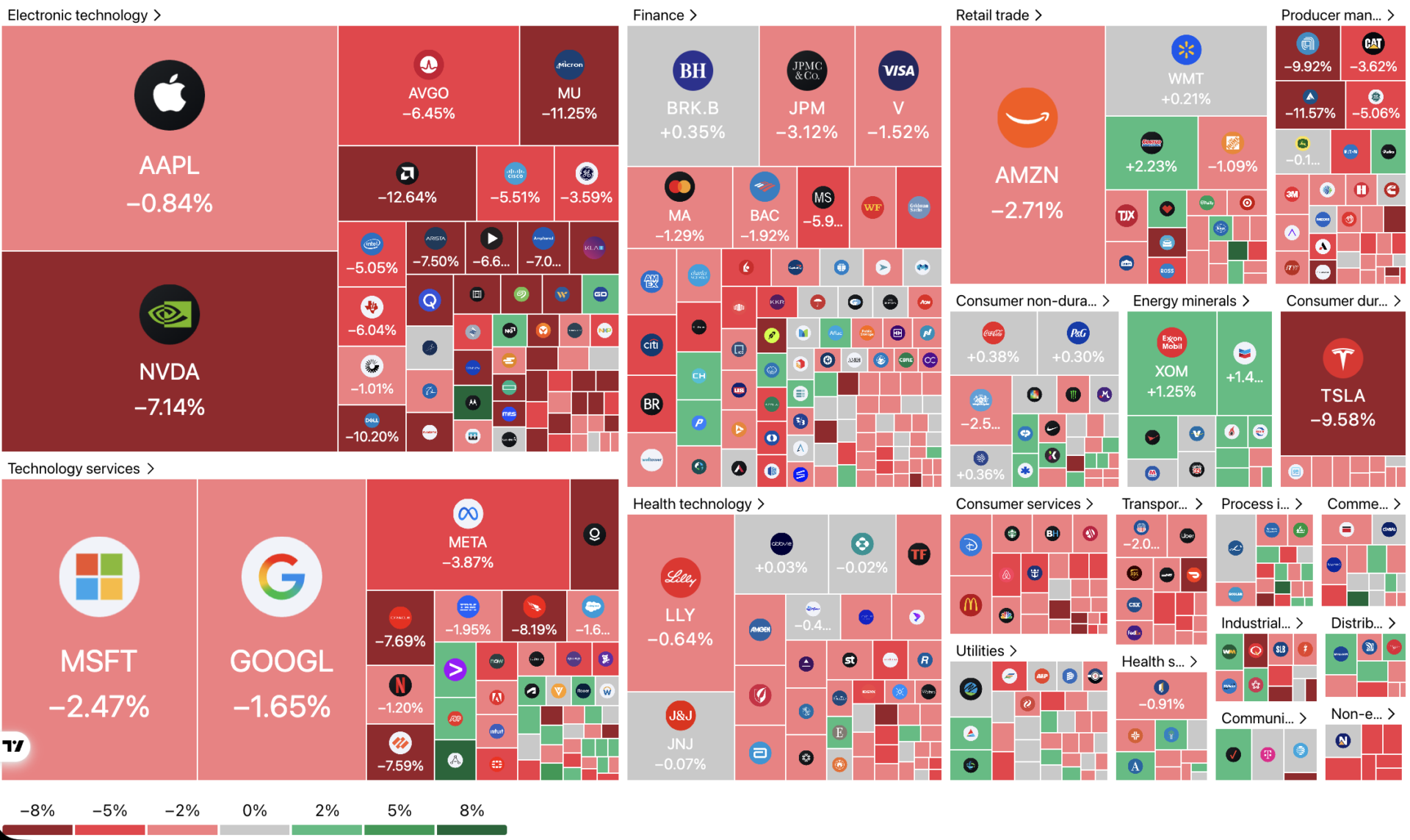
Why did the S&P 500 lose over $2 trillion in 40 minutes today?

The S&P 500 just lost roughly $2 trillion in market value in 40 minutes, and Wall Street has the midterm elections to thank for a good part of the panic.
Thursday’s selloff came after Democrats won control of both chambers of Congress, leaving investors worried about what happens next to America’s expensive AI ambitions.
The index dropped 2.8%, wiping out Wednesday’s 1.6% gain, while losses across the broader market exceeded $2.3 trillion by midmorning.
The funny thing is that investors were celebrating those same election results just a day earlier. Apparently, 24 hours was enough time for Wall Street to reconsider the whole thing.
Why the election results sent AI stocks crashing
Democrats didn’t just win Congress. They also captured important governorships, giving the party more influence over how states handle the construction of AI data centers.
This creates challenges for tech companies that have spent billions on their infrastructure. Any new rules will make power costs more expensive and will hinder the construction process. Everyone is wondering whether the industry can produce profits as expected from its huge investments.
AMD crashed 12%, while Nvidia and Broadcom each lost around 6%. Oracle suffered a similar decline, and the iShares Semiconductor ETF (SOXX) plunged 8%.
Qualcomm was facing a whole other issue. It managed to beat the earnings estimates of the Street, but thanks to its poor outlook, its stock price fell by 11%. Clearly, that was not good enough for it.
Tesla’s price went down by 9%, SpaceX by 7%, and Dell by 10%. Things got particularly ugly for companies selling computing capacity to AI developers. CoreWeave dropped 9%, Nebius sank 13%, and Iren lost 14%.
The Nasdaq Composite declined 3.9%, putting it more than 10% below its October record and officially in correction territory.
Not even the Dow Jones Industrial Average escaped. It fell by 1,153 points, representing 2.2% of its value.
The selloff is all the more intriguing because of what happened on Wednesday, when the Dow soared by more than 1,500 points, its most bullish day since April 2025.
Gold surges as oil and Treasury markets react to Dem midterms sweep
However, prices of oil rebounded on Thursday following their steep decline the prior day on speculation about the Democrats’ ability to put enough pressure on President Trump in order to end the military campaign in Iran.
West Texas Intermediate appreciated by more than 2%, closing above the mark of $90 per barrel. The futures for Brent rose by a similar percentage and approached $97.
The fall in the prices of energy helped relieve inflation worries, but investors were looking elsewhere for shelter.
December gold futures climbed to $4,155.80 per ounce, the highest since October 22. December silver futures hit $53.49, their highest since October 29.
Both metals benefited from a weaker dollar and declining Treasury yields, which made assets without interest payments relatively more attractive.
Gold has risen by over 5% this week and is set to record its biggest weekly gain since August 7. Silver has risen by over 6% this week, its best performance since August 21.
The mining stocks followed suit. The VanEck Gold Miners ETF rose by around 1% on Thursday and its weekly rise has been over 10%.
The Harmony Gold and IAMGOLD rose by over 13% this week, while the Equinox Gold has risen by over 15%.
Meanwhile, Wall Street’s CBOE Volatility Index, commonly called the fear gauge, reached 22.59 as investors rushed to protect themselves against further losses.
The labor market turned out to be surprisingly positive in light of the turmoil.
As per Thursday’s Labor Department data, initial jobless claims dropped by 6,000 to 189,000 in the week ending October 31.
Economists surveyed by Dow Jones thought there would be 197,000 claims filed. This number is in line with July’s low, a number similar to those recorded since September 1969.
The number of continuing claims rose by 23,000 to reach 1.72 million. This indicates that there were more people in America getting unemployment benefits after their claims.
This story was originally published by Cryptopolitan. Read the original article.