XRP Ledger Takes Another Step Toward Institutional Lending — Could This Change XRP’s Future?

The XRP Ledger is moving closer to expanding its role in institutional finance after the XRP Ledger Foundation and VS1 Finance released an open-source lending application that allows developers to test an entire loan process on the blockchain. The development follows growing validator support for the network’s proposed lending amendments, which Bitcoinist previously reported could significantly expand XRPL’s financial capabilities.
The application, announced by VS1 Finance on November 18 and highlighted by the XRP Ledger Foundation on November 19, combines five separate network features into a working lending environment.
Although the system is currently available only on Devnet, it offers developers an opportunity to examine how institutional lending could eventually operate directly on the XRP Ledger.
For XRP holders, the development raises an important question: could lending become another driver of network adoption?
XRP Ledger Introduces Working Lending Application
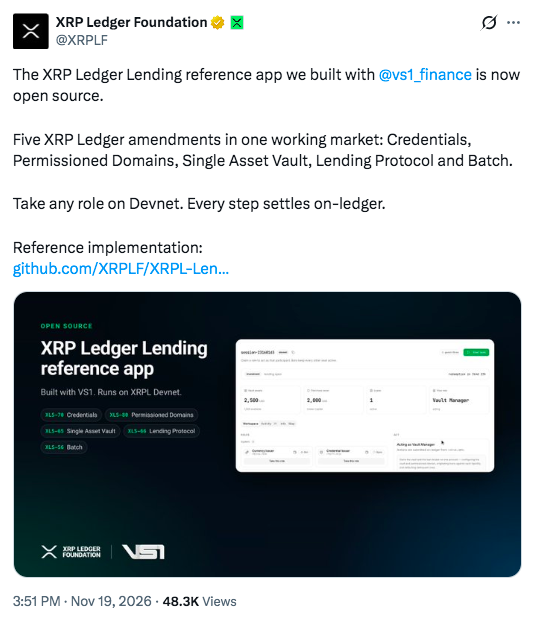
The XRP Ledger Foundation confirmed that its lending reference application, developed alongside VS1 Finance, is now open source.
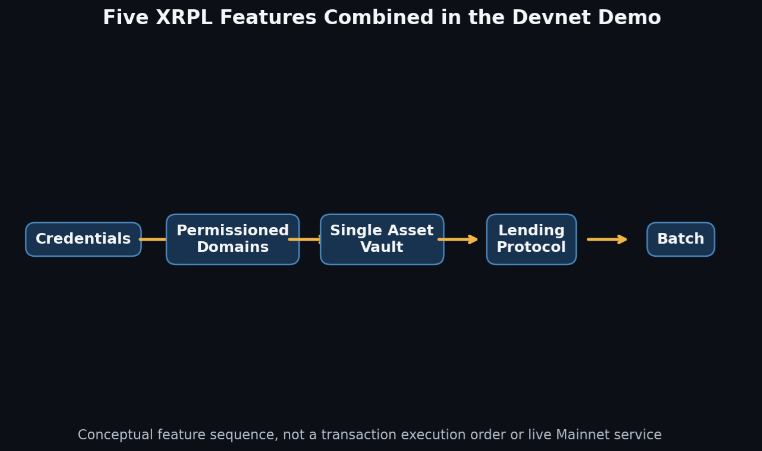
The application combines Credentials, Permissioned Domains, Single Asset Vault, Lending Protocol, and Batch functionality into one testing environment.
Rather than examining these features individually, developers can now simulate how they interact throughout the lending process.
In a November 19 X post, the XRP Ledger Foundation explained that developers can test different lending roles on Devnet, with the associated transactions recorded on the ledger.
According to VS1 Finance’s official announcement, the application is intended to provide developers with a common starting point for building lending services.
However, the company emphasized that it is a reference implementation rather than a production-ready financial product.
That distinction matters because lending applications still require credit assessment, legal agreements, and compliance procedures beyond the blockchain itself.
How Institutional Lending Could Work On XRP Ledger
The proposed lending system introduces a different approach from many existing decentralized finance platforms.
Instead of requiring borrowers to lock cryptocurrency as collateral directly within a smart contract, the XRPL Lending Protocol supports fixed-term loans with credit assessments performed outside the blockchain.
Loan brokers evaluate borrowers, manage credit risks, and establish repayment conditions.
Meanwhile, lenders deposit assets into Single Asset Vaults, allowing pooled capital to fund approved loans.
The protocol records loan issuance, repayments, interest obligations, and outstanding balances on the XRP Ledger.
This structure could appeal to financial institutions that want blockchain-based settlement while retaining familiar credit-management practices.
Ripple has also been exploring how blockchain lending could support payment providers and financial businesses requiring short-term liquidity.
The initiative builds on earlier XRPL developments, including validator discussions surrounding network upgrades.
We believe the combination of institutional credit processes and blockchain settlement could become an important part of XRPL’s longer-term development.
However, the system’s success will depend on real-world adoption and the ability of lenders to manage borrower risk.
XRP Ledger Validators Move Closer To Lending Approval
While the reference application is operational on Devnet, the proposed lending features still require validator approval before becoming available on Mainnet.
According to the November 20 voting snapshot, the Single Asset Vault amendment had received support from 25 of 35 validators.
The Lending Protocol amendment and its accompanying update had each received 24 supporting votes.
With 35 validators in that snapshot, at least 29 supporting votes would be required to exceed the network’s 80% consensus threshold.
Importantly, that level of support must be maintained for two consecutive weeks before an amendment can activate.
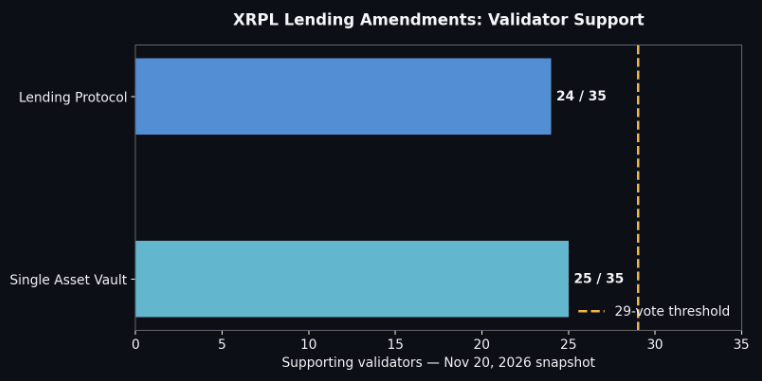
The latest figures suggest that validator support has improved, although neither amendment had reached the required threshold in the November 20 snapshot.
Developers must also consider network stability and the interaction between proposed features before activation.
Consequently, the release of a working reference application should not be confused with the official launch of institutional lending on the XRP Ledger Mainnet.
Could Native Lending Increase Demand For XRP?
The potential implications for XRP extend beyond the lending application itself.
If financial institutions begin using XRPL for credit services, the network could experience greater transaction activity and broader participation.
However, the relationship between lending adoption and XRP demand is not straightforward.
The protocol supports lending with different assets, including stablecoins issued on the network.
For example, Clearpool and Cicada Partners are developing an institutional lending product involving Ripple’s RLUSD stablecoin.
In that arrangement, borrowers would receive and repay RLUSD rather than necessarily purchasing XRP.
Nevertheless, XRP remains the network’s native asset, supporting transaction fees and account reserve requirements.
Greater activity could therefore expand the network’s utility, although it would not automatically produce substantial XRP buying pressure.
The development also comes as Bitcoinist’s earlier coverage of XRP Ledger lending highlighted the importance of distinguishing technical progress from actual institutional demand.
What Comes Next For XRP?
The next major milestone is validator approval of the Single Asset Vault and Lending Protocol amendments.
Developers are also preparing for a scheduled November 25 Devnet and Testnet reset, which will remove existing test-network accounts, balances, and transactions.
The reset will not affect Mainnet.
For the lending initiative, the reset offers another opportunity to evaluate whether applications can reproduce their expected behavior in a fresh testing environment.
Looking further ahead, the introduction of native lending could expand the XRP Ledger’s role beyond payments and asset transfers.
Financial institutions may eventually use the network for credit origination, loan administration, and repayment settlement.
However, commercial adoption, loan volumes, and the potential impact on XRP’s market price remain uncertain.
The latest development is therefore best understood as a meaningful technical milestone rather than confirmation of an institutional lending boom.
For XRP investors, the coming validator decisions and subsequent deployment activity will provide more useful evidence of the network’s long-term financial potential.
This story was originally published by Bitcoinist. Read the original article.