Amazon tells defenders to automate after China-linked AI agents breach a campus

After a previously unknown flaw allowed AI agents to breach a university server, Amazon advised security teams to automate their attack response.
An operator linked to China allowed the agents to choose each step toward their single aim.
According to an Amazon report by Amazon Integrated Security chief information security officer CJ Moses, organizations should prioritize high-confidence detections that trigger automatic actions, with humans monitoring outcomes, not approving each step.
An agent that finds and exploits a zero-day in minutes “completes its activity faster than many security operations centers can manually triage an alert,” Moses wrote. Makers don’t yet know about zero-day defects, hence no fix exists.
Cairn cracked an unknown MONAI Label flaw in about 11 minutes
On September 10, 2026, Amazon Threat Intelligence detected the campaign. The operator left a Cairn server live without a login, so anyone could view its prompts, settings, and AI output.
An open-source platform, Cairn, guides several AI agents through penetration testing, authorized breaches companies order against their own systems. Users tell it in simple words where to start and where to go, and it will navigate there.
Logs showed IP addresses associated with East Asian universities outside mainland China were attacked for about 48 hours starting September 8. The operator input a target list and variants of a single order, “obtain shell access,” which means remote command of a machine.
“Based on those inputs, the AI agents planned, executed, and adjusted their approach as they learned, without the operator choosing each next step,” Moses wrote.
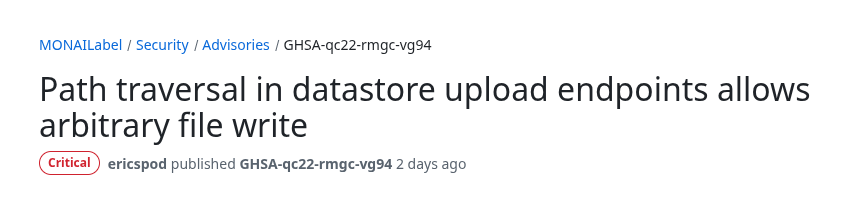
A server running an open-source medical imaging AI was hacked. Agents mapped its API, found an upload endpoint with a filename parameter, and tested it for path traversal, which lets attackers write files outside the app’s accepted folder.
The agents could write files anywhere on the server about 11 minutes after mapping the API. In another session, they put a Python reverse shell into sitecustomize.py, a file Python loads on startup, and gained root, the machine’s highest account.
Amazon determined with “high confidence” that the bug was a zero-day, since there was no fix, advisory, or previous mention of it. The operator then sent the agents a proxy to a second university’s network, where a server ran the same susceptible software.
Amazon believes the operator exploited the zero-day to compromise that machine and open the tunnel. Amazon told the maintainers and they fixed the code.
The software is called MONAI Label, a GitHub advisory published Nov. 18 says. It classifies the path traversal bug as critical and cites the original report from AWS.
Redis attempts ran 148 actions over 16 hours without a break
Over the course of roughly 16 hours, the agents carried out 148 consecutive activities against a university’s Redis server, an in-memory database that was left open without a password.
They sought to exploit Redis replication to inject rogue code, get out of its scripting sandbox, re-write config files and corrupt memory. They also ran a Log4Shell exploit on some other service on the same machine.
The agents then mapped the internal Docker network by taking advantage of a server-side request forgery vulnerability in a Qdrant database on that host. Passwords were then sprayed against SSH, PostgreSQL, and other services, but none of them worked.
A university GPU server was impacted by a different push for over 6 hours. Agents attempted over 30,000 credential combinations without success, and they compiled a list of about 80 actual usernames from faculty directories, lab sites, archived pages, and papers.
The agents “ran continuously for 16 hours without breaks, sleep, or working-hour constraints,” Moses wrote.
Based on Chinese Simplified prompts, scripts set to China Standard Time, and targeting likely of strategic significance to China, Amazon evaluates the China link with moderate confidence. AWS notified the victims via a government partner because they were not AWS customers.
A financially motivated organization using Cairn to target online retailers was also separately documented by Gambit Security. On November 17, Google researchers said they discovered Cairn in intrusions at American aerospace companies.
Cryptopolitan reported in May that Google had found the first known zero-day exploit created with the help of artificial intelligence. The first of OpenAI’s models to receive a critical cyber risk rating was the Astra model in September.
This story was originally published by Cryptopolitan. Read the original article.