Binance completes proof of reserves after $6.3B hack as withdrawals resume

Binance has provided new statistics that back its commitment to protecting customers after a hack that cost $6.3 billion.
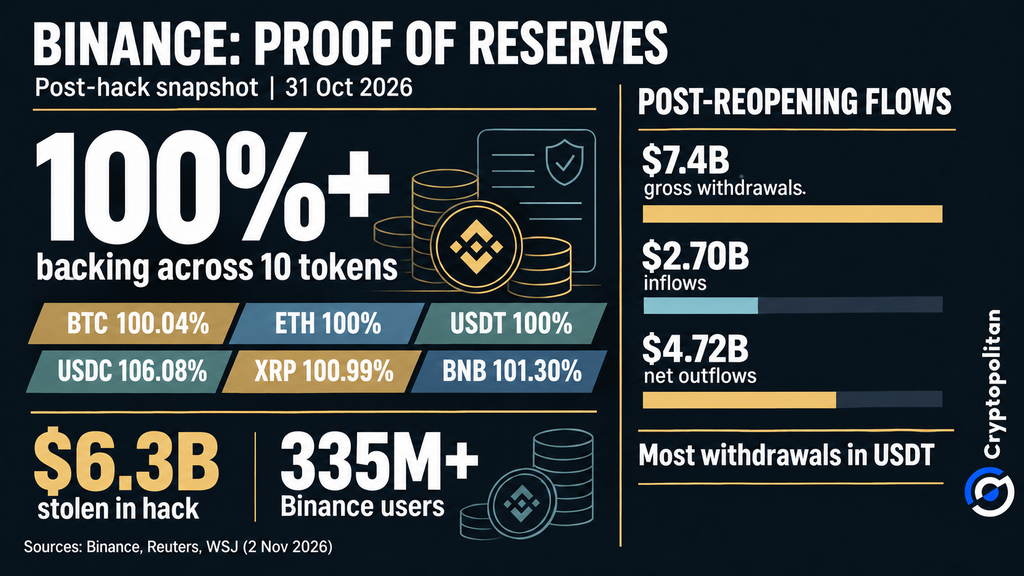
The company conducted a cryptographic verification of its reserves snapshot as of October 31 on Monday. It verified that at least ten major tokens are backed one-to-one. Its 335 million users can verify it for themselves, even though this is no solvency audit.
What the latest proof shows
Binance has issued its most recent reserves snapshot at 00:00 UTC on October 31. The document cites Bitcoin block 973895 as the benchmark. The latest proof presented uses Merkle tree and zk-SNARKs technologies. These cryptographic tools allow users to confirm the presence of their balance without handing account-specific details.
The reserve ratios were 100.04% for Bitcoin, 100% for Ether and USDT, 106.08% for USDC, 100.99% for XRP, and 101.30% for BNB. All of the ten tokens listed can be said to be fully backed, which is not the case for other assets.
To fix this situation, Binance is planning to do a snapshot on November 4. The new proof will probably require an additional 40-50 hours for its generation.
$4.72 billion out, $2.7 billion back in
Customers moved quickly when withdrawals reopened November 1. Binance processed about $7.4 billion in gross withdrawals, the Wall Street Journal reported, citing a company spokesperson. But $2.7 billion flowed back in, leaving $4.72 billion in net outflows, roughly 3% of platform assets.
Most withdrawals were in USDT. Other exchanges gained deposits, though their origins are unclear. Binance has handled similar huge outflows in the past; it saw about $6 billion in net outflows over 72 hours after FTX collapsed in 2022.
Crypto prices are showing signs of stabilizing. Bitcoin recovered above $77,000 by Monday after hitting a six-week low, while Ether rebounded from a two-month low.
Bitwise researchers André Dragosch and Luke Deans summed up the market’s response:
“Market reaction was sharp but orderly.”
Replaced funds versus frozen funds
According to Binance, approximately 95% of the impacted assets have been replaced using the company’s funds. However, the remaining tokens are less liquid, hence taking quite some time to source.
Binance has allocated 100% of the funds, it's just 5% remaining to convert to some of the small coins taking time. https://t.co/9Edm6M23vw
— CZ 🔶 BNB (@cz_binance) November 2, 2026
While asset replacement can be done, retrieving the stolen cryptocurrencies is another story. Elliptic researcher Dr. Tom Robinson has revealed that the amount of frozen or seized cryptocurrencies reached $2.85 billion, with $3.24 billion still being in the addresses involved in the theft.
However, these funds have not been converted into fiat currency. Elliptic tracked about 12,000 wallets and over 40,000 operations on 11 blockchains. Moreover, the FBI discovered that the North Korean TraderTraitor group is responsible for the breach that happened on October 29.
Why a reserves snapshot is not an audit
Proof of reserves offers a snapshot of an exchange’s holdings, but it cannot guarantee future solvency or security. A 2025 IEEE Access study highlights a theoretical weakness: exchanges could manipulate snapshots to understate their liabilities. The PCAOB also cautions that these reports are not equivalent to audits.
Those limitations matter even more after a major security breach. As TRM Labs policy chief Ari Redbord told Reuters:
“A hack at a crypto exchange is bank robbery at the speed of the internet”
The scale of Binance’s attack adds to those concerns. Bitwise compared the $6.3 billion theft with Bybit’s $1.5 billion hack in 2025. The incident has also revived questions about where investors should keep their crypto. As Cryptopolitan reported, experts are weighing the relative safety of ETFs, self-custody and decentralized platforms.
Phased withdrawals and a scam warning
Binance resumed selected crypto withdrawals on Sunday, followed by US-dollar cash withdrawals on Monday. More networks will reopen in stages.
But the reopening has also given scammers an opportunity. Binance warned on X about impostors targeting users through emails, direct messages, group chats, and even small transfers. It urged customers to rely only on official channels.
Attention now turns to the November 4 reserves snapshot, wider withdrawal access, and efforts to recover more stolen funds.
This story was originally published by Cryptopolitan. Read the original article.