Block Discloses Proposed $764M DOJ Payment in Anti-Money-Laundering Resolution
TL;DR: Block, the payments company behind Cash App and Square, says it reached an agreement in principle with the US Department of Justice over an anti-money-laundering programme allegation. Its November 3 filing outlines approximately $964 million in gross monetary terms and a potential $764 million net payment after credits, but the resolution still requires a final agreement and court approval.
Crypto investors often think of compliance risk in terms of exchanges. A new filing from Block is a reminder that the same financial-crime obligations also shape mainstream payment apps that let customers use bitcoin alongside ordinary money transfers.
In its third-quarter Form 10-Q filed November 3, Block said it reached an agreement in principle during October with the US Department of Justice. The contemplated deferred prosecution agreement would address an allegation that the company failed to maintain an effective anti-money-laundering programme under the Bank Secrecy Act.
What the proposed agreement actually says
The filing describes a gross monetary component of roughly $964 million. Credits related to earlier regulatory resolutions would reduce the expected net payment to approximately $764 million, according to the company. Block says it accrued that latter amount as of September 30, 2026.
Under the contemplated arrangement, prosecutors would defer the relevant charge for three years. If the company fully complied with the obligations in a final agreement over that term, the DOJ would seek dismissal of the deferred charge.
None of this means the matter has already been settled in court. Block explicitly says the resolution is subject to a satisfactory final agreement and judicial approval. It also cautions that the company cannot guarantee the parties will reach final terms, and that losses could exceed what it has accrued.
That distinction matters in headlines. An agreement in principle is meaningful because it describes a possible route out of a substantial legal dispute. It is not the same as a completed final settlement or a judicial finding that every allegation has been resolved.
Why Cash App’s scale raises the stakes
Block is best known for the Cash App and Square ecosystems. Cash App users can interact with bitcoin, but the company also provides payments, cards, lending and other financial tools. A breakdown in monitoring or due diligence controls can affect far more than a narrow crypto trading product.
The DOJ inquiry is connected to questions raised about the company’s compliance and risk practices following allegations aired in 2023. Block’s filing notes that a separate Securities and Exchange Commission investigation ended in March 2026 without a recommendation for enforcement action. The end of that separate inquiry should not be confused with the Justice Department’s proposed criminal resolution.
More broadly, investors have been considering the effect of tighter controls across crypto services. NewsBTC has covered stablecoin compliance restrictions affecting Coinbase customers, which addresses a different segment of the market but highlights why operational trust extends beyond fast transactions.
A bigger issue than one legal charge
For a payments business, suspicious-activity monitoring, customer identification and escalation procedures must operate consistently at large scale. Even when individual transactions are small, the number of users and transfers can create a major supervisory challenge.
There is also an important distinction between financial penalties and technology investment. Paying a fine or reaching a deferred prosecution agreement does not by itself prove that controls have been fixed. Regulators and customers will look for the systems, staffing and governance needed to prevent a repeat.
The next step is whether Block and the DOJ complete a final agreement on the announced terms, including any independent monitoring or compliance obligations. Until then, the $764 million figure is the company’s expected net payment under a proposed resolution, not evidence that the case is fully closed.
This article was written by the News Desk and edited by Samuel Rae.
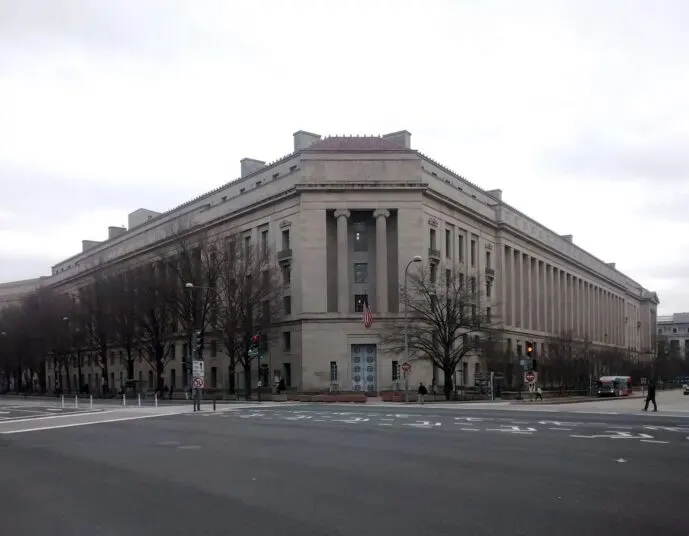
Featured image: Robert F. Kennedy Department of Justice Building in Washington, D.C. Photo: Gunnar Klack via Wikimedia Commons, licensed under CC BY-SA 4.0.
This story was originally published by NewsBTC. Read the original article.