Data center protests spread as US voters back candidates promising tighter rules

Opposition to AI data centers has gone beyond local planning meetings. Last Friday, protesters infiltrated a construction site related to Microsoft in Amsterdam, as the protest mounts in 16 countries. Resistance has reached the US midterm elections: the Democrats won a majority in Congress and some of the winning candidates for governors pushed for better regulations regarding data centers.
Cranes, balloons and a breached fence in Amsterdam
More than 100 activists gathered at the Amsterdam construction site. Some entered the grounds, climbed cranes and hung balloons, Reuters reported. Site owner Pure Data Centres, which plans to invest over $1 billion, offered to discuss the concerns of the protesters. Meanwhile, Microsoft supported peaceful demonstrations but opposed unlawful actions.
The protest in Amsterdam took place concurrently with a two-day campaign by the Stop Dirty Data Centres coalition. The group called on governments to halt any new project until adequate safeguards are established. Furthermore, protests were organized in Dublin, Warsaw, and at another Microsoft data center project in Denmark.
From street protest to the US ballot box
In the US, opposition to data centers became an election issue. Democrats, who won control of Congress, and 32 of 34 winning gubernatorial candidates back tougher data center regulations, AP reported. Twelve gubernatorial candidates supported bans or construction moratoriums. About three-quarters of voters opposed a data center in their community, although most considered other issues more important.
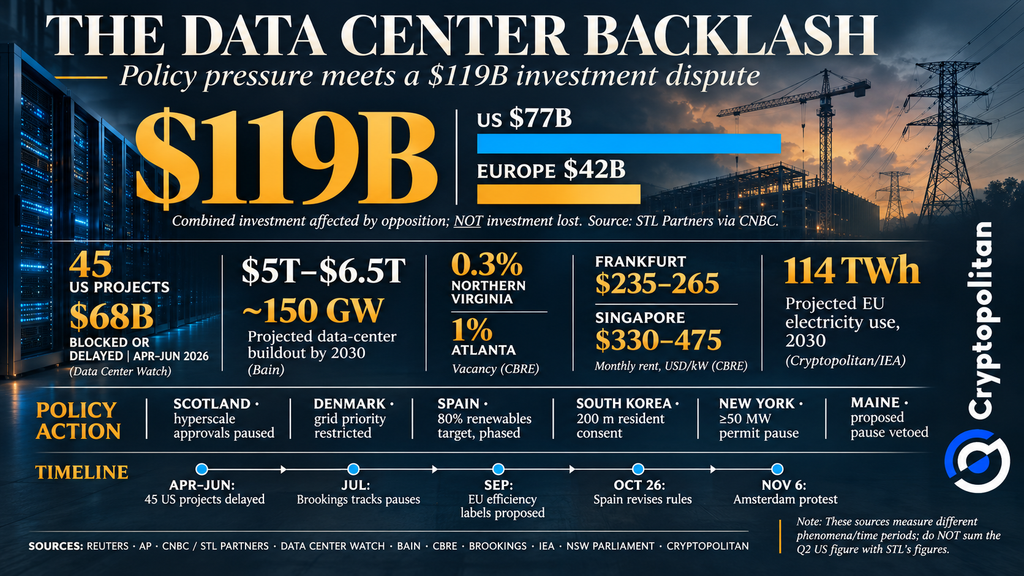
Public protests have interfered with the construction of data centers. Data Center Watch reported that at least 45 projects have been deferred or stalled between April and June, with a total investment of about $68 billion. Meanwhile, CNBC reported that the STL Partners study estimates that opposition has been a factor in about $77 billion worth of data center investments in the US. The studies take various approaches to calculate disruption, and their numbers should not be added or treated as actual losses.
Europe and Asia draw their own lines
Opposition against new data centers in Europe is disrupting major investments. Research cited by CNBC found that European projects affected by delays or cancellations amounted to $42 billion. The $42 billion only reflects affected investment and doesn’t indicate losses. The European Data Centre Monitor found that more than 70 projects have been rejected or blocked from January to April of 2026. This is more than the number of rejected or blocked data center projects for the entire year of 2025.
Governments are responding differently. Scotland paused approvals for new hyperscale facilities, while Denmark can move data centers down the queue for electricity-grid connections. Spain revised its proposal in October. The country retained its proposed 80% hourly renewable-power requirement but gave developers more time to comply. In South Korea, Seoul’s Geumcheon district requires consent from residents living within 200 meters of proposed sites.
The buildout is enormous, and so are the stakes
The regulatory pushback comes as technology companies prepare for a massive expansion. Bain projects $5 trillion–$6.5 trillion in data center spending and roughly 150 gigawatts of additional capacity by 2030.
Meanwhile, available space remains scarce. CBRE recorded vacancy rates of just 0.3% in Northern Virginia and 1% in Atlanta. Monthly rents reached $235–$265 per kilowatt in Frankfurt and $330–$475 in Singapore.
Local opposition adds to an already difficult market. Grid constraints and rising construction costs also limit expansion. Governments are increasingly responding to these pressures. The IEA identified 134 policies governing how data centers connect to electricity systems worldwide. Nearly 40% were introduced or implemented within the past year.
Moratoriums, labels and the search for a middle ground
In the US, construction pauses are becoming a popular response. Brookings found that at least 15 states had considered moratoriums, while more than 100 localities had adopted them. New York suspended environmental permits for facilities using at least 50 megawatts for up to a year. Maine’s proposed pause, however, was vetoed.
Other governments are focusing on oversight. Australia’s New South Wales inquiry identified gaps in planning, water management and electricity-grid oversight but rejected a blanket moratorium.
The EU has proposed A-to-G efficiency labels for data centers above 500 kilowatts, with the first labels expected in 2027. However, only 36% of EU centers reported the required information. That reporting gap matters as the region’s data center electricity consumption could reach 114 terawatt-hours by 2030. These approaches leave governments facing the same challenge: how to expand computing capacity without passing the costs to local communities. Developers may increasingly need to demonstrate who will pay for grid upgrades and how residents will be involved before construction begins.
This story was originally published by Cryptopolitan. Read the original article.