DOJ charges over 800 defendants in largest-ever US anti-scam crackdown
The US Department of Justice (DOJ) announced on November 24 that it had taken action against more than 800 defendants across over 400 cases since March. The country’s largest anti-scam crackdown puts growing pressure on banks, cryptocurrency exchanges, and payment providers that scammers use to move money.
The initiative is based on Executive Order 14390, signed by President Donald Trump on March 6. The executive order requires all federal agencies to take necessary actions against scams committed by transnational criminal organizations.
800 defendants and one executive order
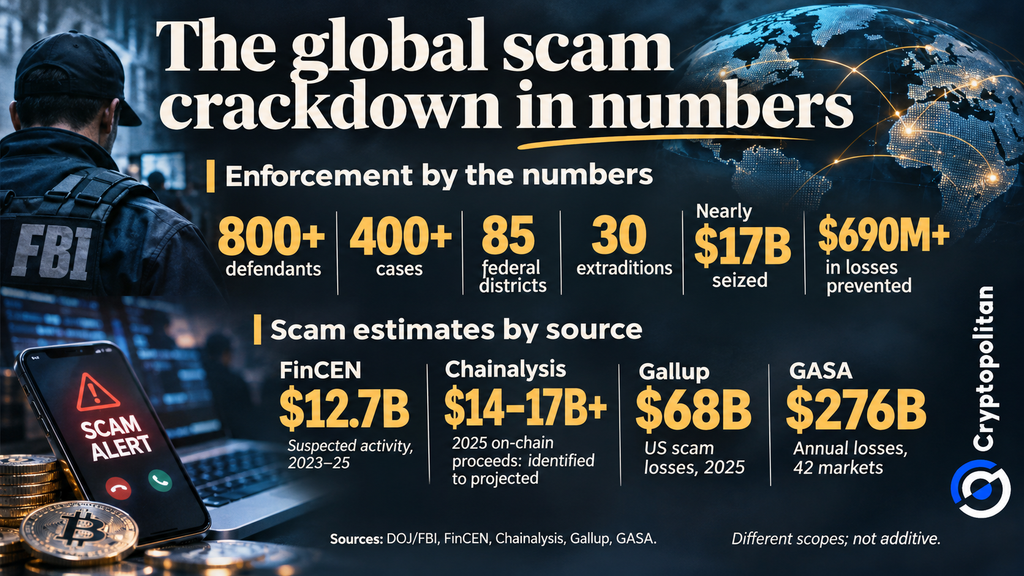
The DOJ coordinated enforcement across 85 federal districts, resulting in new charges, convictions, sentences, and 30 extraditions. US authorities also helped law enforcement agencies in more than 10 countries raid scam centers targeting Americans.
Attorney General Todd Blanche described the results as “just the beginning.”
The campaign is a response to the prevailing scam-based financial losses. According to Gallup, Americans lost $68 billion to scams in 2025.
Seized does not mean returned
As part of a larger operation, the Federal Bureau of Investigation (FBI) is cooperating with foreign agencies via Operation Blackout. The primary objective of this campaign is to break up overseas scam syndicates and to cut off their flow of money.
According to FBI Director Kash Patel, they have seized almost $17 billion in money obtained illegally and prevented the loss of over $690 million.
However, seizing assets and preventing losses are different from compensating victims. Seized money does not need to be paid back to victims. While losses that have been prevented are money that scammers have never gotten.
To address victim compensation, the executive order suggests coming up with proposals for starting a program financed by money that is recovered from criminal organizations.
The money moves through banks and exchanges
In order for authorities to compensate victims, they must first figure out where the money went. Banks and crypto companies provide some vital information.
The Financial Crimes Enforcement Network (FinCEN) identified $12.7 billion worth of suspected crypto scam activity in 33,904 reports from September 2023 to December 2025. Most of those reports were made by banks and money services companies (96%).
Blockchain data also reveal the extent of the problem. Chainalysis traced around $14 billion in cryptocurrency scam profits in 2025. The firm indicates that the amount may go beyond $17 billion as more wallets related to the scams are discovered.
The importance of tracing where the scam money went is illustrated in the example of Cambodia’s Prince Holding Group (Prince Group). In October 2025, its founder, Chen Zhi, was charged by the US prosecutors with conspiracy to commit fraud and conspiracy to commit money laundering. The prosecution was seeking forfeiture of 127,271 bitcoin worth about $15 billion at the time.
US authorities have since targeted businesses and individuals alleged to have helped Prince Group move and hide its funds. The US Treasury slapped sanctions against another 45 individuals and companies on November 5, according to a previous report by Cryptopolitan. This means that the total number of Prince Group-linked sanctions targets is now 226 in three tranches. The latest sanctions intend to dry up the financial means that allow the network to function and sidestep past restrictions.
What Washington is asking of other governments
Washington is also seeking greater international cooperation. The executive order outlines potential sanctions, visa restrictions, and trade penalties against countries that tolerate scam networks.
On November 5, the Financial Action Task Force (FATF), which sets global anti-money-laundering standards, recommended targeting the financial networks that keep scam compounds running.
However, a separate FATF report found that only 46% of surveyed jurisdictions regulate offshore crypto service providers based on their activities within those markets.
Compliance costs climb for the firms in the middle
US financial institutions now spend an average of $4.35 million on fraud prevention, according to a July survey by PYMNTS Intelligence.
Between 2024 and 2026, prevention spending rose by $2.68 million per institution, yet fraud losses still increased by $140,000. Rising compliance costs could make it harder for smaller financial firms to compete.
Visa also identified over $1.4 billion in attempted fraud during the first half of 2026, up 40%, as scammers increasingly use artificial intelligence to target victims across languages and borders.
The risk that the money just moves
Without consistent international regulation, tougher enforcement could simply push criminal proceeds into countries with weaker oversight.
That poses a risk to a global crypto economy that recorded $9.4 trillion in on-chain economic activity in the year ending June 2026.
The Global Anti-Scam Alliance (GASA) estimates annual consumer scam losses at $276 billion across 42 markets. Its November study found that 9% of surveyed adults lost money.
For financial institutions, the challenge is stopping fraud without making legitimate cross-border payments more expensive or less accessible.
This story was originally published by Cryptopolitan. Read the original article.