Druckenmiller invests in Trade[XYZ] as ICE plans regulated Hyperliquid market

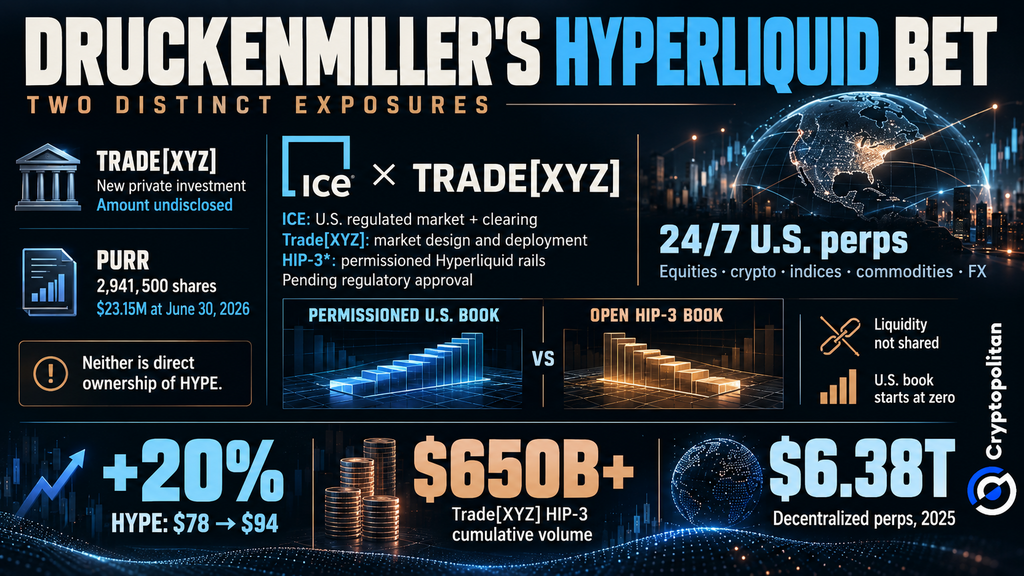
Stan Druckenmiller shared on X on October 29 that he had invested in Trade[XYZ], which develops perpetual futures on Hyperliquid. That same day, Intercontinental Exchange (ICE), owner of the New York Stock Exchange, unveiled plans for a regulated, 24/7 U.S. venue. The new market still needs regulatory approval.
A veteran macro investor, not a crypto convert
In an October 29 post, Druckenmiller said he was “excited to be an investor in trade(xyz)” and hoped the product would “enhance my investment process.” He disclosed no amount. Galaxy called it his first-ever X post.
Druckenmiller’s investment also reflects his views on crypto. In a Morgan Stanley interview, he questioned its role as a store of value. However, he saw practical benefits in blockchain and stablecoins. His Trade[XYZ] investment follows that distinction.
HYPE, Hyperliquid’s native token, increased by about 20%, from $78 to $94, after the announcement. But Druckenmiller’s investment was in Trade[XYZ], not directly in HYPE.
ICE builds a walled-off U.S. venue
The plan of ICE to launch a regulated trading venue operating round the clock in the U.S. was realized through a definitive agreement with Trade[XYZ], which was announced on October 29. As per the agreement, ICE will invest in Trade[XYZ] and will be the exclusive operator of its regulated platforms.
ICE also plans to establish a dedicated U.S. exchange and clearinghouse for the perpetual contracts, subject to regulatory approval. ICE will run the new retail trading platform separately from its existing futures business for institutional investors. Trade[XYZ] will handle the design and deployment of the trading products.
Traders could enter the U.S. market through brokers and futures commission merchants but would be subject to identity and anti-money laundering checks. Perpetual contracts could include stocks, indices, commodities, currencies and cryptocurrencies. These contracts are different from traditional futures as they do not expire.
The market would also use a more restricted version of Hyperliquid’s technology. Galaxy explains that HIP-3*, the underlying framework, uses on-chain allowlists to control access. It is currently on testnet.
From energy perps lobbying to an onshore deal
The partnership follows an August appeal by the Hyperliquid Policy Center and Trade[XYZ] for regulated U.S. energy perps. They pointed to a February oil shock when on-chain trading continued while conventional markets were closed.
Trade[XYZ]’s existing open HIP-3 markets have topped $650 billion in cumulative volume, Galaxy noted. They will keep operating separately. Payward, Kraken’s parent, also plans to become a CFTC-regulated HIP-3* deployer.
Separate order books and the liquidity question
That separation raises a concern: liquidity. The new U.S. venue will not share order books with open HIP-3 markets, Galaxy says. It must attract traders from scratch. During a weekend shock, prices could diverge before arbitrage closes the gap.
Risk controls remain another unknown. Hyperliquid uses on-chain liquidation and, in extreme cases, automatic deleveraging. ICE has not explained whether its clearinghouse would keep or replace those mechanisms.
The market is substantial. Decentralized perps exchanges handled $6.38 trillion in 2025, according to CoinGecko. Talos notes their expansion into traditional assets.
The PURR stake is a different bet
Druckenmiller’s family office has a separate Hyperliquid-linked position. Its second-quarter 13F, filed August 14, listed 2,941,500 shares of Hyperliquid Strategies (Nasdaq: PURR), valued at $23.15 million on June 30.
That public-equity holding differs from his private Trade[XYZ] stake. Neither establishes direct HYPE ownership, and June holdings do not confirm October positions.
This story was originally published by Cryptopolitan. Read the original article.