Ethereum Foundation says its quantum-safe overhaul is tougher than the Merge
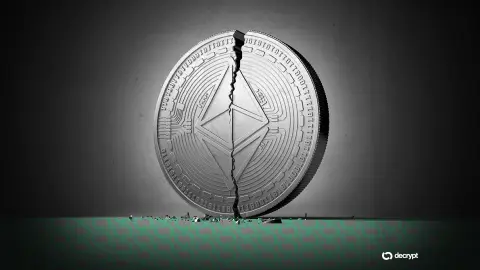
Moving Ethereum to quantum-resistant cryptography is more difficult than the 2022 Merge, according to the Ethereum Foundation.
Additionally, it has less time to finish because AI, not quantum hardware, now controls the speed.
The plan, which is the first in a series the foundation refers to as PQAI, short for post-quantum and post-AI, was outlined by Kev Wedderburn in a post on November 23. “This upgrade is harder than the Merge, and we have less time,” he wrote.
On Sept. 15, 2022, the Merge modified Ethereum’s consensus engine while the chain continued to function. No downtime, no money lost after years of shadow forks and devnets.
There are preliminary specifications. The first post-quantum consensus-layer devnet, pq-cl, is being refined by developers.
BLS and ECDSA give way to hash-based signatures
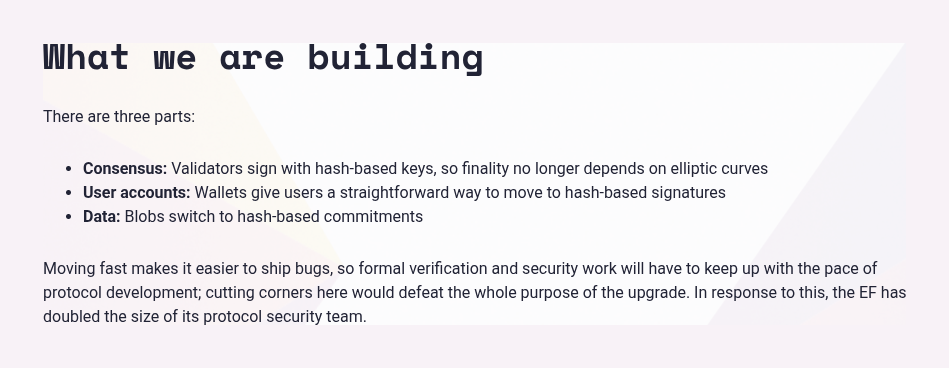
There are three layers to the revamp. Elliptic curves are no longer necessary for finality because validators sign using hash-based keys.
Wallets can switch to hash-based signatures for user accounts.
The blobs, data packets that rollups send to Ethereum, are converted to hash-based commitments.
Currently, Ethereum employs ECDSA for user accounts and BLS signatures for validators. Both could be cracked by a big enough quantum computer.
After more than a year of testing candidate signature schemes, the Foundation decided to use hash-based cryptography. The adjustment doesn’t add any new assumptions because Ethereum already trusts its hash functions, Wedderburn wrote.
In order to prevent quick work from shipping flaws, the foundation doubled the size of its protocol security team. Formal verification and security efforts must keep up with the development of protocols.
Wedderburn ranks AI above quantum computers as the nearer risk
The foundation has been preparing for quantum defenses for years, but “recently AI emerged as a more urgent risk,” Wedderburn wrote. Models already find bugs in production software more quickly than humans can check them, with thousands in the Linux kernel alone.
Wedderburn also cited an AI-assisted proof of the 167-year-old Riemann Hypothesis from a few days prior.
Risk is a shortcut. Without ever having to build a quantum computer, elliptic curve math could be weakened by an AI that discovers better algorithms.
In October, Justin Drake, a researcher at the foundation, voiced the same concern. In the worst scenario, he cautioned, existing signature methods might become insecure in a few months.
December 2028 was suggested as a goal by Drake during Devcon in Mumbai. A timeline review is planned for January, and the foundation’s stated deadline is still December 2029.
To free up engineers, Ethlabs has withdrawn its Quick Slots proposal from the Hegotá upgrade. Developers will discuss what other functionality to remove from the fork during the remaining All Core Devs calls this year.
Rework is required for BLS-based tools. Updates are required for contracts that assume pre-quantum cryptography.
Wallets, staking pools, and multisigs all require modifications. Larger signatures entail keeping an eye on the hardware specifications so users can continue to operate nodes at home.
A standard elliptic-curve signature consists of about 64 bytes. The quantum-resistant ML-DSA-44 standard needs 2,420.
Approximately 42 million ETH, or 54.6% of ETH on Ethereum’s execution layer, sits behind public keys disclosed in previous transactions, according to Cryptopolitan. The figure is a gauge of future risk, not an active attack.
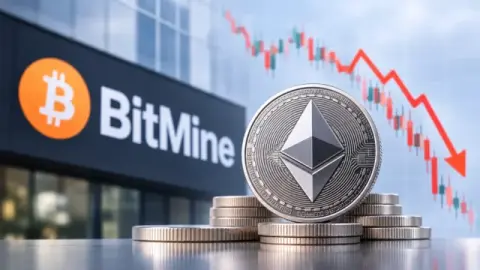
At the time of writing, ETH was trading at $1,663, down 1.8% in the past 24 hours.
This story was originally published by Cryptopolitan. Read the original article.