Google ties school Search access to its AI in K–12 policy reversal

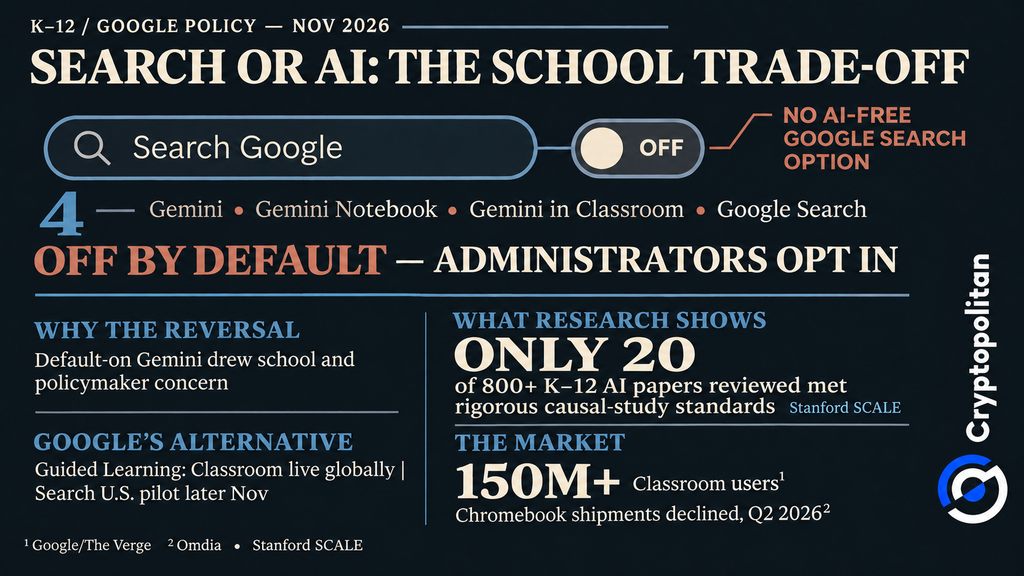
Google is reversing course on AI in schools. In a November 3 announcement, it said Gemini, Gemini Notebook, Gemini in Classroom, and Google Search will be off by default for K–12 student accounts until administrators enable them. But schools rejecting AI-powered Search must also lose ordinary Search.
What administrators can and cannot turn off
Administrators can enable the four services individually. Yet Google offers no AI-free Search option for these accounts. “Search and AI are deeply integrated,” education vice president Chris Phillips told The New York Times, according to The Verge. Students whose schools decline Search will see an unavailable notice.
Google has announced the changes, but they have yet to take effect. The company says it will share more details in the coming months. For now, schools must plan their next steps without knowing exactly how the new controls will work.
Why Google is walking back its defaults
This change comes after Google’s decision earlier this year to turn Gemini on by default in Classroom. Google Classroom has over 150 million users among educators and students. Lawmakers voiced their concerns regarding the possible harms of AI in classrooms, while educators are concerned that instant answers may lead students not to think independently.
According to Google, it altered its approach in response to feedback from educators, researchers, and lawmakers. Worries surrounding the use of AI technology in Search are not only prevalent among educational institutions. As Cryptopolitan previously reported, DuckDuckGo’s AI-free search engine experienced a sudden increase in traffic, thrice that of its normal rates. While the figures indicate that some users are inclined to use the search engine without AI, it does not explain whether school authorities share those sentiments.
Guided Learning: classroom tool now, Search pilot later
Google has come up with an alternative named Guided Learning, which aims at asking questions or discussing issues instead of giving finished results. The global rollout of this new feature took place at Classrooms on November 3, where teachers could assign tasks and track their students’ progress. At the end of the month, the Search version will undergo pilot-testing in certain schools across the US.
A Google-initiated trial conducted on over 300 students at the University of Tokyo has demonstrated the potential impact of Guided Learning. It has been shown to improve learning outcomes by 8.1 percentage points in comparison to standard internet resources with only 5.3 percentage points improvement. However, this test only covered a single half-day statistics session and is not representative of long-term K–12 learning.
What independent research actually supports
A Stanford review examined a repository of more than 800 AI-in-K–12 papers and found just 20 rigorous causal studies. Guided tutoring looked more promising than chatbots delivering answers, but performance without AI was mixed; none of the identified high-quality student-use studies took place in U.S. K–12 classrooms.
The OECD likewise says general-purpose AI can improve work without strengthening learning. Brookings warns that dependence and cognitive offloading could undermine the “productive struggle” students need.
The distribution question behind the policy
Google’s Classroom, Workspace and Chromebook presence makes changing platforms complicated. Bundling AI with Search may leave districts choosing between accepting AI features and removing a familiar research tool.
Meanwhile, Omdia reported declining Chromebook shipments in the second quarter of 2026, partly reflecting component shortages and softer education demand—not this policy. What matters next is whether schools tolerate the Search tradeoff, and whether Google’s U.S. pilot changes that calculation.
This story was originally published by Cryptopolitan. Read the original article.