IOSCO flags quantum-upgrade costs after Solana testnet throughput falls 90%

The effort to make blockchains resistant to quantum attacks may prove to be expensive. In its report released on November 19, the International Organization of Securities Commissions (IOSCO) said that the use of larger signatures may cut network throughput and increase transaction fees. The organization notes the case of the Solana testnet, whose reported processing capacity dropped by about 90%.
As per an April interview with CEO Alex Pruden, Project Eleven carried out the tests with the Solana Foundation. However, the report did not specify the signature scheme, testing hardware or baseline throughput. Consequently, the outcome has not been replicated and does not predict Solana’s mainnet performance.
The greater concern here is the size of these signatures occupy and what effect they have on the transaction fees instead of how quickly they get verified.
Why post-quantum signatures weigh so much on a blockchain
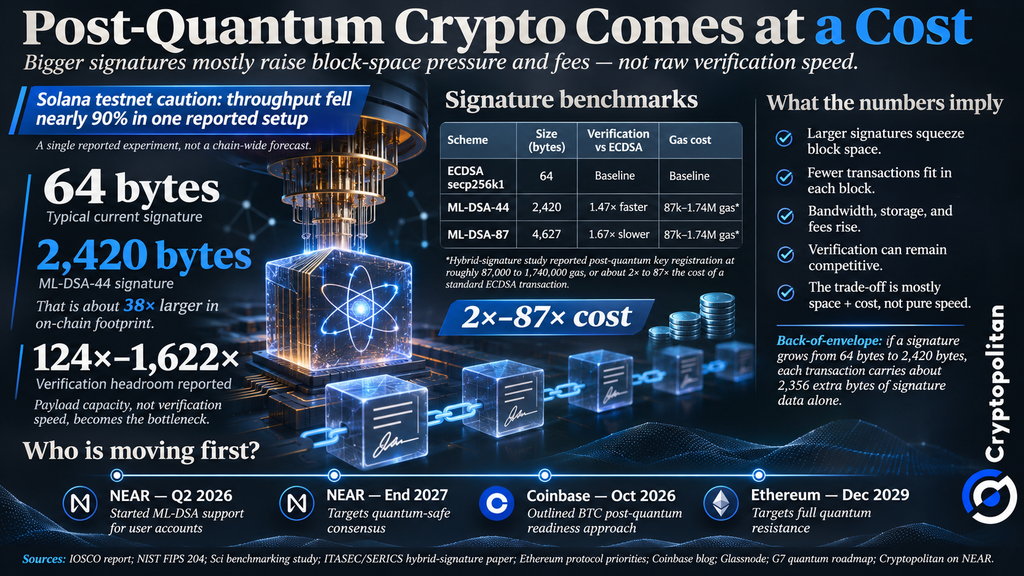
The biggest challenge with post-quantum signatures is their size. Today’s elliptic-curve signatures typically use just 64 bytes. By comparison, ML-DSA-44 signatures require 2,420 bytes under NIST’s standard, nearly 38 times as much space.
Larger signatures mean that fewer transactions can be accommodated in each block. They also put more strain on the network’s bandwidth and storage capacities.
To put the difference into perspective, Cryptopolitan calculates that switching from a 64-byte signature to ML-DSA-44 adds 2,356 bytes per transaction. For every 1,000 transactions, that adds up to 2.356 megabytes of extra signature data.
The calculation only accounts for the size of the signature. Actual performance of the network also depends on other transaction data and how the blockchain processes it.
What the benchmarks actually show
Larger signatures do not always mean slower verification. A November 3 study found that ML-DSA-44 verified signatures 1.47 times faster than ECDSA secp256k1. ML-DSA-87, however, was 1.67 times slower.
The researchers also reported verification headroom ranging from 124 to 1,622 times. Their findings suggest that limited block space could be a bigger obstacle than verification speed, although results depend on the testing conditions.
Transaction fees are also a point of concern. An additional study on Ethereum found that the registration of post-quantum keys took anywhere from 87,000 to 1.74 million gas units. This amounts to around 2 to 87 times the cost of a standard ECDSA transaction.
The two studies used different testing methods, so their findings should not be taken as fixed costs or performance measures across all blockchains.
Bitcoin and Ethereum are already running the clock
With these challenges in mind, major crypto networks are working on ways to prepare for quantum threats.
The Ethereum Foundation aims to make its execution, consensus and data layers quantum-resistant by December 2029.
Bitcoin faces similar challenges. Coinbase, which says it holds around 12% of Bitcoin’s supply, has suggested exploring a gradual transition. One option would allow users to spend Bitcoin using either classical or quantum-resistant keys.
The potential exposure is already significant. Glassnode estimated that 6.04 million BTC had exposed public keys as of May 2026. However, those coins are not necessarily at immediate risk, and exposure does not mean they have been stolen.
What it means for exchanges, stablecoins and tokenized assets
Some networks have already begun making changes. As Cryptopolitan reported, NEAR started introducing quantum-resistant signatures for user accounts in the second quarter of 2026. The network aims to extend that protection to its consensus system by late 2027.
The transition also matters for exchanges, stablecoin issuers and platforms handling tokenized assets. These businesses may face higher settlement costs and more complicated custody arrangements as blockchain networks adopt new cryptographic standards.
Financial regulators are urging institutions to prepare. The G7 roadmap recommends identifying systems vulnerable to quantum attacks and coordinating upgrades before those systems become exposed to practical threats. The challenge is finding a way to strengthen security without making blockchain transactions too costly or difficult for businesses and users.
This story was originally published by Cryptopolitan. Read the original article.