Korea preps stock rescue fund unused since 2008 as AI rout hits KOSPI
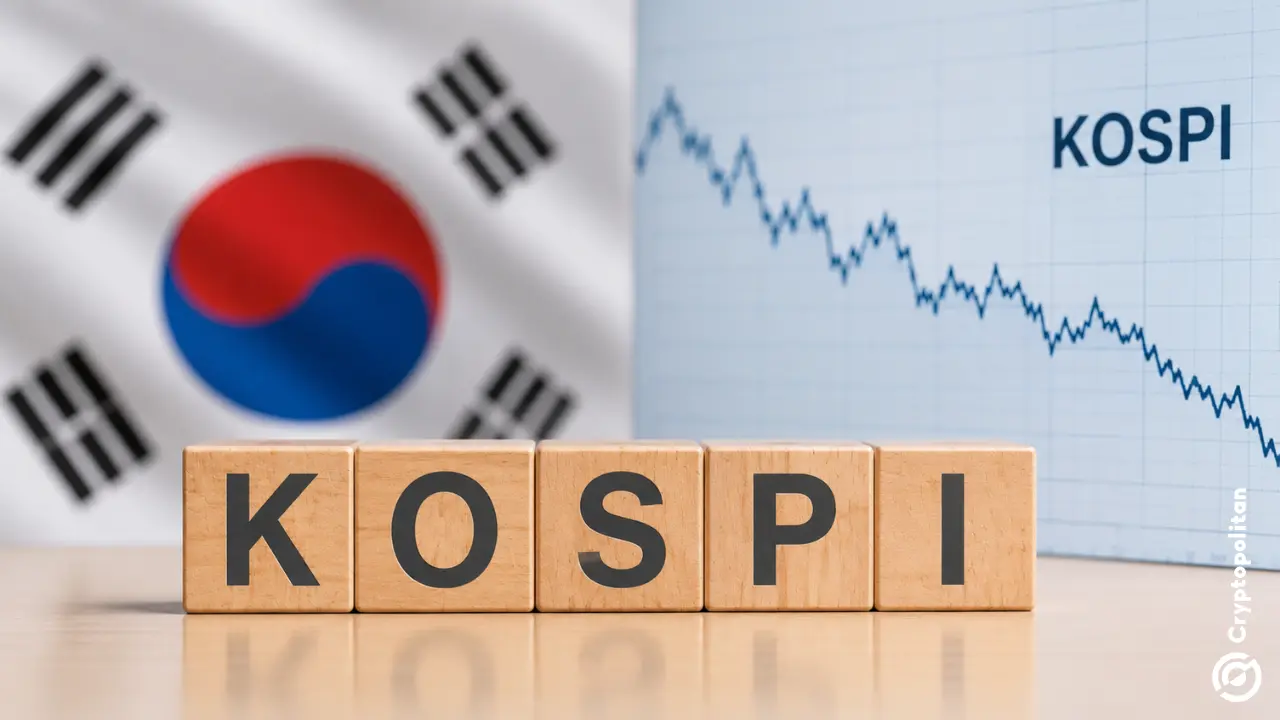
South Korea is preparing a stock market rescue fund that was last used in 2008. The rescue fund is needed due to its main stock index losing nearly half its value since June.
Analysts doubt the fund is big enough to turn the market around. The government also made it easier for companies to buy back their own shares and promised closer checks on illegal short selling.
What is South Korea doing to stop its stock market from falling?
South Korea’s main stock index, the KOSPI, hit a record 9,114.55 on June 22. That rise was driven by a boom in computer chips and artificial intelligence (AI), and it briefly made SK Hynix (KRX: 000660) the most valuable stock in Seoul.
Since then, the index has fallen sharply, experiencing a 5.21% drop on Friday, November 20 to 4,869.96, its lowest recorded close in about 10 months. On Monday, it slid further, reaching 4,633.22 by late morning.
Finance Minister Lee Hyoung-il held an emergency meeting on November 22 with the heads of the Bank of Korea, the Financial Services Commission and the Financial Supervisory Service.
Afterward, he promised to get a “market stabilization fund” ready to use at short notice. Such a fund collects money from financial firms and uses it to buy products that track the KOSPI in order to calm panic selling. Officials have not said how big the fund will be or when it will start.
Korea has set up these funds in 1990, 2003, 2008 and 2020, but the last time the fund was actually used was back in 2008.
Back then, the government built a fund of 500 billion won (about $370 million) and spent 103 billion won (about $77 million). The KOSPI rose 5.8% that day.
The 10.76 trillion won (about $8 billion) raised during the 2020 pandemic was never used because stocks recovered on their own. In September and October 2022, the Financial Services Commission got the same 10.76 trillion won pool from 2020 reactivated, but it was never executed.
After Seoul’s market closed on Friday, the Nasdaq Composite fell by 5.28%, and the PHLX Semiconductor index dropped 10.73%. Nvidia (NASDAQ: NVDA) lost 14.01% and AMD (NASDAQ: AMD) fell 13.25%. Investors are doubting whether AI spending will pay off, and are also reacting to the resignation of Nvidia’s former chief executive, Jensen Huang.
Beyond organizing a fund, the government took two other steps. For three months starting Tuesday, November 24, it is relaxing the daily limits on how many of their own shares listed companies can buy back because those shares can help lift a stock’s price.
The Financial Supervisory Service and the Korea Exchange will also spend three months watching more closely for illegal short selling, which is a way of betting that a stock will fall. They will also monitor investors borrowing money to buy stocks, and the forced selling that follows when those loans go bad.
Seoul did not place a ban on short selling outright, even though many small investors want one. On Friday, traders sold about 1.41 trillion won (about $1.05 billion) of shares short. SK Hynix (KRX: 000660) and Samsung Electronics (KRX: 005930) were responsible for 159.7 billion won (about $119 million) and 133.8 billion won (about $100 million), respectively.
Over the full week, foreign investors accounted for 78.5% of the 6.52 trillion won (about $4.9 billion) in short sales on the KOSPI and the KOSDAQ.
Taiwan, on the other hand, directly banned short sales of shares priced below the previous day’s closing price. It also raised the minimum collateral for short selling to 150% from 130%.
How big does the fund need to be?
Manishi Raychaudhuri, who runs Hong Kong-based Emmer Capital Partners, has stated that anything under 25 trillion to 30 trillion won (about $19 billion to $22 billion) wouldn’t be enough to save the market.
He pointed out that the KOSPI is worth close to 3,000 trillion won (about $2.2 trillion) and that more than 40 trillion won (about $30 billion) of shares often change hands in a single day.
Notably, two reports that could have an effect on the fund’s effectiveness are expected this week. The U.S. personal consumption expenditures index for October, a key measure of inflation, is due on November 25, while the Bank of Korea is expected to set its base interest rate on November 26. Some economists expect it to rise to 3.25% from 3.00%.
This story was originally published by Cryptopolitan. Read the original article.