Michael Saylor Explains When Strategy Buys Bitcoin — And Why It Sometimes Chooses STRC Instead

Michael Saylor has offered a closer look at how Strategy decides between buying more Bitcoin and repurchasing its preferred shares, revealing a capital allocation approach that goes beyond accumulating BTC whenever prices fall.
In a November 20 post on X, the Strategy executive chairman shared highlights from the company’s latest investor Q&A, featuring CEO Phong Le and host Natalie Brunell. The discussion addressed Bitcoin per share, shareholder value, preferred-stock repurchases, and the company’s ability to meet financial obligations during prolonged market downturns.
The timing is particularly interesting. As institutional Bitcoin exposure continues to attract attention, Strategy is demonstrating that managing its financial obligations can be just as important as expanding its Bitcoin treasury.
How do we decide when to buy Bitcoin and when to buy back $STRC?


Why Strategy Sometimes Chooses STRC Over Bitcoin
During the investor discussion, Saylor and Le examined the conditions under which Strategy issues equity, purchases Bitcoin, or repurchases STRC, its variable-rate preferred stock.
The distinction matters because each transaction serves a different purpose.
Purchasing Bitcoin expands Strategy’s exposure to the digital asset. Repurchasing STRC, particularly when shares trade below their $100 stated amount, can reduce outstanding preferred obligations and improve the company’s financial flexibility.
Strategy’s latest disclosures illustrate the difference.
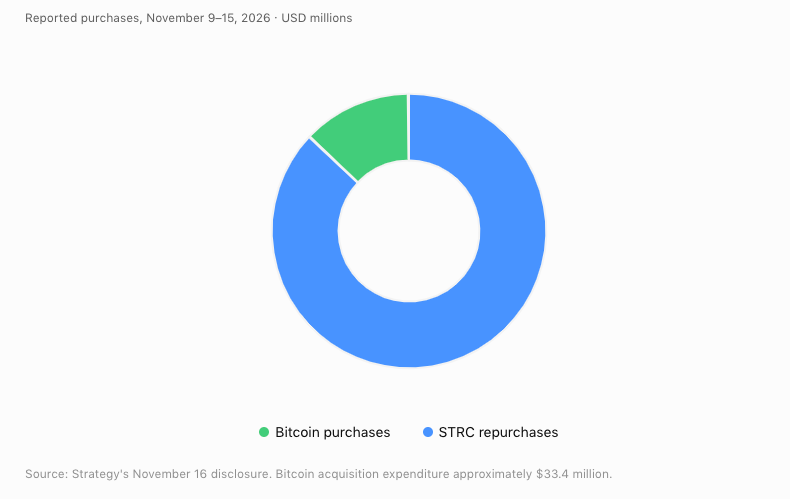
Between November 9 and November 15, the company purchased 485 BTC while spending approximately $228.1 million repurchasing STRC shares. The Bitcoin acquisition cost roughly $33.4 million.
That means Strategy allocated substantially more capital to preferred-stock repurchases than direct Bitcoin purchases during that reporting period.
However, this does not necessarily indicate declining confidence in Bitcoin. Instead, the company appears to be balancing long-term BTC accumulation with the financial structure supporting that strategy.
Similar questions about corporate Bitcoin holdings have become increasingly relevant as investors examine how companies manage their digital asset treasuries.

Michael Saylor Highlights Bitcoin Per Share
Another important topic from the November 20 discussion was Bitcoin per share, a metric Strategy uses to evaluate how its financing decisions affect shareholders.
Saylor distinguished between gross and net Bitcoin per share, explaining why investors with different time horizons may interpret the measures differently.
Gross Bitcoin per share reflects the company’s Bitcoin exposure relative to its assumed diluted share base, while net Bitcoin per share accounts for relevant financial claims and liabilities.
The broader question is whether Strategy can increase the economic value attributable to shareholders through its capital-market activities, rather than relying entirely on Bitcoin price appreciation.
This is particularly relevant when the company issues new shares to finance acquisitions or repurchases.
Although additional Bitcoin purchases can increase total holdings, issuing equity also changes the ownership denominator. As a result, the number of BTC held by Strategy is not the only metric investors should monitor.
Growing institutional Bitcoin positions reinforce the importance of understanding how different financial structures provide exposure to BTC.
Can Strategy Keep Buying Bitcoin During A Downturn?
Strategy’s financial resilience was another central theme of the Q&A.
According to its latest reporting, the company held 850,849 BTC as of November 15, alongside approximately $4.9 billion in US dollar assets.
Its dollar reserves and other liquid assets are intended to help support preferred dividends, debt obligations, and broader treasury management.
The company has also reported approximately 3.4 years of coverage for interest and dividend obligations at prevailing rates.
These financial considerations are detailed in Strategy’s official third-quarter 2026 financial results, which provide additional context for its Bitcoin treasury and capital-market activities.
That liquidity provides a buffer against prolonged Bitcoin weakness, although future financing conditions, dividend rates, and market volatility remain important considerations.
For Bitcoin investors, the central takeaway is that Strategy’s accumulation model is becoming more sophisticated.
Rather than treating every available dollar as an automatic Bitcoin purchase, management is weighing the benefits of increasing BTC holdings against strengthening the financial instruments that support those holdings.
Saylor’s latest remarks suggest that Strategy still sees Bitcoin as its core long-term asset, while capital management is playing an increasingly important role in determining how the company expands its exposure.
This story was originally published by Bitcoinist. Read the original article.