OpenAI readies more compute to take Private Inference past its alpha testers

OpenAI is procuring confidential computing capacity to take Private Inference far beyond the few customers testing it today.
The alpha feature permits business prompts and model answers to be kept behind closed doors while OpenAI’s systems work on them.
Shekar calls the alpha a first step
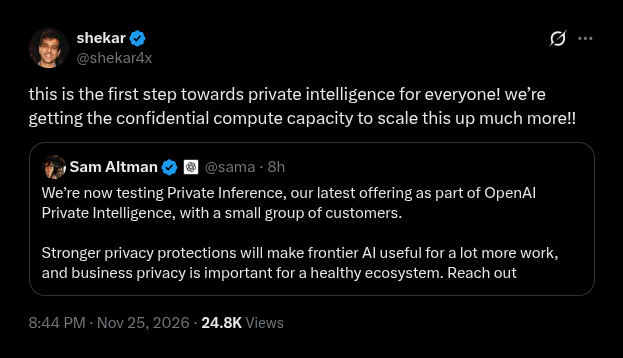
In a post on X on Wednesday, Shekar of OpenAI said the test was “the first step towards private intelligence for everyone”. He said OpenAI is getting access to confidential compute capacity to scale it up a lot more.
OpenAI has not said which models Private Inference supports, how much it will cost or when it will be generally available.
Chief executive Sam Altman opened the trial in an X post, steering interested firms to Shekar. “Stronger privacy protections will make frontier AI useful for a lot more work, and business privacy is important for a healthy ecosystem,” Altman said.
The post garnered over 7,000 likes within one day.
Private Inference executes the work on confidential computing chips that are insulated from the rest of the system. OpenAI’s page pairs it with “strict verifiable controls” and calls it an alpha and an API preview.
Apple uses a similar approach for Siri requests sent to its cloud. OpenAI’s page says business customers own their inputs and outputs, and offers zero data retention and Private Inference “for eligible workflows.”
Altman says automated safety reviews keep staff away from content
Private Inference is the second part of OpenAI’s Private Intelligence, a privacy bundle first revealed at DevDay on September 29. The first, Private Safety Processing, checks for misuse, without any retention of customer data by OpenAI.
OpenAI previewed it on August 19, and started rolling it out to API customers in phases on September 22.
Under zero data retention, OpenAI does not retain any prompts or model responses after a request has been fulfilled. OpenAI is also developing an option to store content on its own infrastructure, encrypted with keys controlled by the customer.
Altman said that with Private Safety Processing, OpenAI is able to run automated safety reviews under zero data retention. Staff cannot see the underlying content.
In September, Cryptopolitan reported that Nvidia, Palantir and Booz Allen Hamilton began scaling back on the use of OpenAI and Anthropic models over fears they could learn from customers’ intellectual property.
Both AI firms deny training on corporate inputs. They acknowledge holding “some metadata.”
OpenAI’s Private Safety Processing post observes that enterprise data is not used to train OpenAI models unless customers opt in.
Rival Anthropic on Monday launched Enterprise Frontier Safeguards in beta. Companies keep their own data, and the system looks for abuse.
Anthropic’s cyber program grew in October, and required organizations to permit data retention to monitor for cyber misuse.
Anthropic wanted to match its cyber protections with no data retention. Eligible organizations may store data in cloud infrastructure they control.
This story was originally published by Cryptopolitan. Read the original article.