SEC says crypto governance voting alone does not make token holders a controlling group
It is possible for token holders to vote on a crypto network without being in control of it. According to an update to its crypto-assets FAQs on November 2, the SEC’s Division of Corporation Finance stated that voting by itself does not classify individuals as controlling group members. The important question is who truly is in control of the network.
A control test, not a token-distribution test
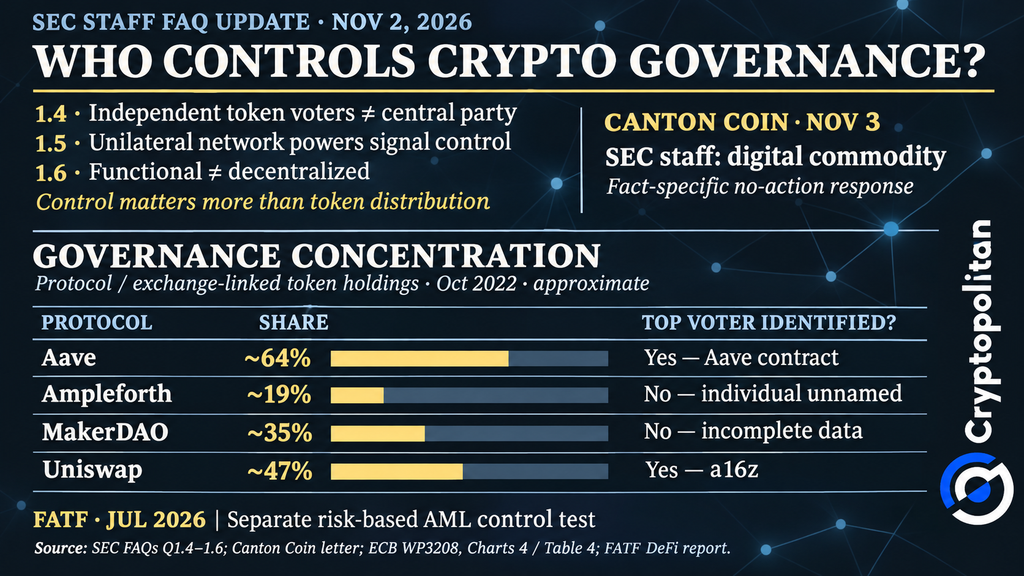
Question 1.4 of the SEC’s November 2 crypto-asset FAQ update explains when governance voters could collectively qualify as a “central party.” Unaffiliated individuals who vote independently generally are not considered a ‘group of persons or entities’ when determining whether a network has a “central party.”
However, if they coordinate outside the governance process, the SEC staff may consider them a group. Even if they coordinate, a group qualify only as a “central party” if they have actual control over the operations, economic decisions, or voting process of the network.
The SEC’s March 17 Interpretive Release establishes the underlying principle:
“A functional crypto system does not have a central party that oversees participation or distributes rewards to users.”
Within Question 1.5, one can find specific examples of this type of control. Some of these instances involve the use of the unilateral power to limit access to the network, to pick validators, to change the voting rules, to alter code or to cancel transactions.
The examples shed light on how the SEC staff determines whether control exists. However, it does not create any additional conditions or requirements under the relevant law. The FAQs merely present views of the SEC staff and do not constitute binding SEC rules.
Functionality and decentralization are measured separately
Question 1.6 takes up a related subject: the functionality of a crypto network is not equivalent to different from its decentralization. A network may use its token exactly as intended and still be controlled by a person or group. Therefore, functioning as intended does not imply decentralization.
The FAQ also clarifies how the SEC staff assesses claims made to investors. Whether an issuer fulfilled its promises of functionality or decentralization depends on how it described those milestones in its marketing, not on a general market standard.
Canton Coin gets a narrow yes
On November 3, the SEC staff offered an example with Canton Coin. In a no-action response, Deputy Chief Counsel Jonathan A. Ingram wrote:
“the Division is of the view that Canton Coin is a ‘digital commodity’”
The staff based its decision on what Canton’s lawyers said about the coin. They explained that its value comes from how the network operates and from supply and demand. They also said its value does not depend on managers generating profits for investors. According to the lawyers, no single person or group controls the network.
However, there were restrictions to the no-action response. The SEC staff declared it would not endorse an enforcement action regarding how the particular Canton Coins are created without securities registration. Also, Ingram cautioned that different circumstances may lead to a different conclusion.
What the governance data actually show
Identifying who controls a crypto network is harder than tracking its tokens. An ECB working paper found that the top 100 holders owned over 80% of governance tokens in four protocols: Aave, Ampleforth, MakerDAO and Uniswap.
The study covered 2022–2023. Its October 2022 figures put protocol- or exchange-linked holdings at roughly 64%, 19%, 35% and 47%, respectively. Many leading voters could not be identified.
Concentrated ownership also has economic consequences. A 2026 Management Science study linked it to slower platform growth, although other factors can soften the impact.
Governance disputes show how this plays out. Cryptopolitan reported that ENS founder Nick Johnson held about half of active delegated votes despite owning roughly 3% of supply. This prompted a proposal to delegate five million treasury tokens. Meanwhile, Compound holders are voting on tighter treasury delays and veto powers.
FATF is asking a different question
The SEC is not the only regulator examining who controls DeFi networks. FATF’s July 2026 report takes a different approach. It calls for a functional, risk-based assessment of control to address money-laundering risks.
The two frameworks serve different purposes. The SEC focuses on securities classification, while FATF addresses financial crime. Both, however, raise a practical question for institutions and DAOs: who actually has the power to make decisions?
This story was originally published by Cryptopolitan. Read the original article.