SpaceX commits over $74B to Texas and Arizona AI supercomputing campuses

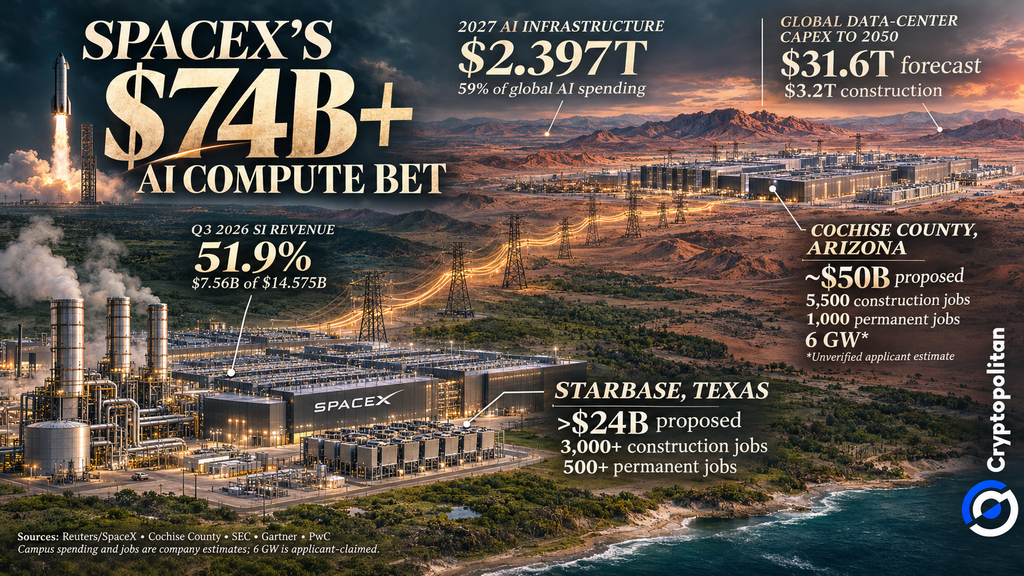
On Thursday, SpaceX announced its plans to invest over $74 billion in the construction of two AI supercomputing facilities in Texas and Arizona. More than $24 billion will be invested in Texas, while an estimated $50 billion will be spent in Arizona. These amounts are planned, not amounts already spend. The issues of energy supply and permitting are still unsolved.
A self-powered gas plant on 444 acres in Texas
The construction work has commenced on the approximately 444-acre Starbase site belonging to SpaceX. However, neither the proposed supercomputer facility nor the gas power plant are yet running. Local media confirm ongoing construction work at the site, while permit records confirm the approval of land grading. According to SpaceX, the proposed power plant will produce electricity without depending on the public grid.
The Starbase City Commission will have a public hearing on December 9 to discuss SpaceX’s request for a property tax exemption for the project and the associated development agreement. However, the hearing is not meant to decide on the project’s final approval.
SpaceX claims that it has created more than 3,000 jobs in this project in Texas, though this figure is still unverified. More than 500 permanent jobs are expected to be available after the project starts its operations.
Meanwhile, the transfer of the land for the data center construction has attracted attention. Brownsville had removed the land from the city’s limits before Starbase annexed it, meaning the land lies outside the scope of Brownsville’s data center moratorium. Officials from the city made the following statement:
“Residents should have confidence that their concerns about data center development, water resources, energy consumption and responsible growth are being taken seriously.”
A 6-gigawatt proposal and a 2,400-signature petition in Arizona
In Arizona, SpaceX is still waiting for approval from the county. According to Cochise County records, the resource company Tombstone Resources L.L.C. has submitted an application for a development on a piece of land measuring about 747 acres. The project will include up to nine computing buildings and will be implemented in four phases. It is estimated that the site will need six gigawatts of electricity at full capacity. The figures have not been verified independently by county officials. A public hearing will be held on December 9.
SpaceX projects 5,500 construction jobs and 1,000 permanent positions. The company also says the campus would use dry cooling, with no planned industrial groundwater use. SpaceX further claims the project could lower electricity bills for local cooperative members by up to 20%. These benefits remain unverified.
Meanwhile, opposition is growing. Reuters reports that a 2,400-signature petition urges county officials to reject the permit.
Where the money comes from
The company’s SEC filing puts third-quarter Super Intelligence revenue at $7.56 billion, or 51.9% of its $14.575 billion total. Those are reported revenues, unlike the campus investment plans.
SpaceX also announced a roughly $40 billion lease-financing commitment for AI chips, known as GPUs. The agreement covers computing equipment, not another campus. The amount should therefore not be added to the $74 billion planned for Texas and Arizona.
A $2.4 trillion infrastructure bet with a physical ceiling
Gartner expects AI infrastructure spending to reach $2.397 trillion in 2027, or 59% of global AI expenditure. Spending on AI-optimized servers could jump from $527.6 billion in 2026 to $957.2 billion in 2027.
John-David Lovelock, Gartner’s distinguished vice president analyst and chief of research, explained the demand:
“Faster than anticipated expansion of user requirements into scaling up inference workloads, coupled with increasingly compute-intensive training workloads, continues to increase spending on AI infrastructure…”
PwC estimates $31.6 trillion in global data-center capital expenditure through 2050, including $3.2 trillion for construction. These remain forecasts, not spending commitments.
Power and cooling as the real constraint
Electricity could decide how much of that investment happens. PwC warns about limited power access, while the IEA points to pressure on grids, equipment supplies and local resources.
Cryptopolitan previously reported that SpaceX slowed some data-center work over power redundancy and cooling problems. The December hearings bring those practical concerns back into focus. Approval and commercial returns remain uncertain.
This story was originally published by Cryptopolitan. Read the original article.