Switzerland confirms its first AI-agent hacks, four of five got in

Switzerland’s cybersecurity office has confirmed its first cyberattacks carried out by AI agents. There have been five instances in recent days, four of which have successfully gained access to their targets.
The agency’s director, Florian Schütz, provided the numbers to Swiss public radio on Thursday.
Two of three critical infrastructure operators were breached
The National Cyber Security Centre (NCSC) is led by Schütz. According to him, three of the five incidents targeted operators of critical infrastructure, and two of those breaches were successful.
No significant disruption occurred. The organization does not know who is responsible for the attacks and has not identified any victims.
Some small and medium-sized businesses that reported the intrusions themselves were among the victims. At least two sectors were affected by attacks.
In Switzerland, providers of drinking water, power, and telecommunications are examples of critical infrastructure.
AI agents had completely compromised victims’ systems in every instance that the NCSC was aware of at the time of its first public disclosure, a security advisory dated Nov. 24. There had been four breaches out of five attempts as of Thursday’s telecast.
The change in the number was not explained by Schütz or the advisory.
“These cases represent a shift in the cyber threat landscape,” the advisory said. It cautioned that there will probably be more successful, quick intrusions.
The attackers used what the NCSC calls “agentic offensive frameworks.” With minimal human guidance, these AI agents search for vulnerabilities, select their own tools, evaluate the outcomes, and decide what to do next.
The same program is used by an attacker breaking in or a defender doing a penetration test. That dual-use conundrum is immediately highlighted by the agency.
Long-standing weak points are targeted by agents. Default or guessable passwords, as well as known flaws in unpatched software that interacts with the internet.
It’s new to have speed. They can locate these weaknesses and take advantage of them in a fraction of the time it takes a human, and when a defense kicks in, they switch to a different strategy, reducing the window of opportunity to detect an attack and respond.
NCSC wants critical patches installed within 24 hours
CyberStrikeAI and ARTEX were included in the advisory as examples of agents that anybody can access online. It did not state whether either was applied in the five Swiss cases.
According to NCSC estimates, the quantity of these freely available tools has close to doubled since October. The number does not represent confirmed attacks or victims; rather, it represents accessible tools.
A larger wave is anticipated, according to Raphael Reischuk, co-founder of Switzerland’s National Test Institute for Cybersecurity. He thinks businesses underestimate the risk.
Italy’s CSIRT Italia described mass compromise campaigns in an official bulletin. Within hours, autonomous agents were able to get access to numerous systems by chaining flaws, misconfigurations, and stolen credentials.
ARTEX, CyberStrikeAI, PentAGI, and DeepSeek Harness were all listed in the bulletin. Since September 2026, there has been a noticeable rise in AI-assisted attacks, according to Britain’s NCSC.
The European Commission has verified that its HR, medical reimbursement, and translation systems were accessed by attackers using ARTEX. On October 22, the breach was initially found.
According to Cryptopolitan, Microsoft linked six hacker groups connected to China, North Korea, and Cambodia to the open-source ARTEX program on November 25. 3,783 servers with exposed ARTEX consoles were found by SecurityScorecard.
According to IBM’s 2026 data, the average cost of an AI-enabled breach was $6 million.
The Swiss recommendation focuses on the time advantage of the attackers. The NCSC wants passkeys or multi-factor authentication on all web-exposed systems, and critical updates applied to internet-facing systems within 24 hours of their release.
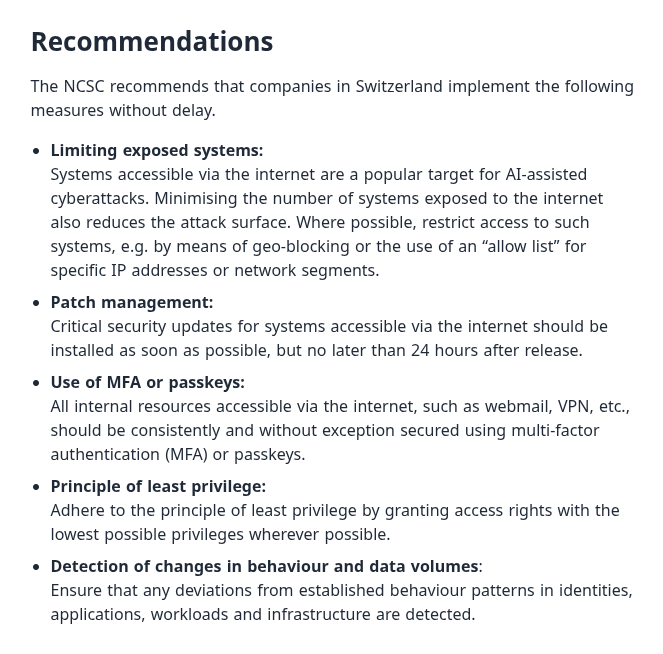
Additionally, it calls for the least amount of access privileges, fewer systems that are exposed through geo-blocking or allow lists, and notifications on unusual changes in data volumes and behavior. According to the NCSC, it regularly communicates with partners abroad and shares technical indicators with operators of critical infrastructure.
This story was originally published by Cryptopolitan. Read the original article.