XRP Ledger Lending Proposal Gains Momentum As Validators Move Closer To Approval
The XRP Ledger is moving closer to introducing native lending capabilities, a development that could expand the network’s role in institutional finance. Validator support for the proposed lending protocol has increased in recent weeks, bringing the blockchain closer to an upgrade that would allow financial institutions and other participants to access fixed-term lending directly through the network.
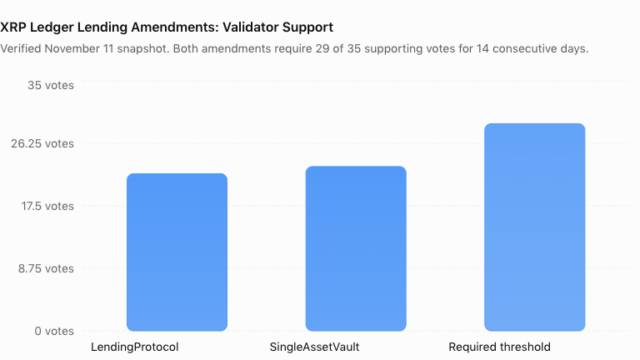
According to the November 11 voting snapshot, the LendingProtocol amendment received support from 22 of the XRP Ledger’s 35 trusted validators, while the accompanying SingleAssetVault amendment secured 23 votes.
Both proposals require at least 29 supporting validators for two consecutive weeks before activation.
Although the amendments have not yet reached that threshold, growing support suggests the network is making progress toward a potentially significant expansion of its financial infrastructure.
XRP Ledger Lending Proposal Gains Validator Support
The proposed lending system has attracted additional validator support since October.
On October 19, the LendingProtocol amendment had 19 supporting validators. That figure increased to 22 by November 11, representing approximately 63% of the trusted validator group.
Meanwhile, SingleAssetVault increased from 21 to 23 supporting validators, equivalent to approximately 66%.
According to the XRP Ledger amendment tracker, LendingProtocol needed seven additional votes, while SingleAssetVault required six at the time of the snapshot.
These amendments are designed to work together, meaning both must receive sufficient approval before the lending infrastructure can operate on the XRP Ledger mainnet.
Importantly, reaching 29 votes would not result in immediate activation. The proposals must maintain the required majority for 14 consecutive days.
This approval process allows validators to evaluate proposed changes before they become part of the network.
As we previously reported, XRPL lending development has continued throughout 2026, with developers refining the protocol’s technical specifications and risk-management mechanisms.
The increasing support is encouraging, although the final activation timeline remains uncertain.
How Native Lending Could Transform The XRP Ledger
The proposed lending system would introduce new financial capabilities directly into the XRP Ledger.
Under the framework, users could deposit supported assets into shared vaults, creating liquidity pools that loan brokers could use to issue fixed-term loans.
Unlike many decentralized finance lending protocols, the proposed system would not require borrowers to provide collateral directly to the protocol.
Instead, loan brokers would be responsible for assessing creditworthiness, managing lending risks, and providing first-loss capital.
Ripple has already explained how this system could operate in traditional financial markets.
In a June 29 official statement, Ripple’s Jasmine Cooper outlined the proposed lending infrastructure and its potential applications for institutional finance.
Cooper explained that the protocol separates credit decisions from loan execution, allowing financial institutions to retain control over underwriting while using the blockchain to manage repayment schedules, interest calculations, and settlement.
Ripple also provided a practical example involving a payment provider that needs short-term liquidity while waiting for a cross-border transaction to settle.
Instead of relying entirely on a traditional bank credit line, the provider could potentially access liquidity through an institutional lending facility built on the XRP Ledger.
This approach could make the network more attractive to institutions familiar with traditional credit markets.
We believe the development is particularly interesting because it represents another step toward connecting blockchain infrastructure with traditional financial services.
Rather than focusing exclusively on cryptocurrency transfers, the XRP Ledger could eventually support a broader range of financial activities.
Could Institutional Lending Increase XRP Demand?
One of the biggest questions surrounding the proposal is whether expanded lending capabilities could influence demand for XRP.
The answer depends largely on how institutions and other participants use the network after activation.
The XRP Ledger already supports payments, tokenized assets, and decentralized trading.
Adding native lending could create additional opportunities for liquidity providers and financial institutions.
Ripple’s broader institutional DeFi roadmap has highlighted the company’s ambitions to expand XRP Ledger functionality across payments, collateral management, and on-chain credit.
If lending activity increases, the network could experience greater transaction volume and broader participation.
However, higher lending activity would not automatically translate into an equivalent increase in XRP demand.
The proposed system can support different assets, and institutional participants may choose to use stablecoins or tokenized financial instruments rather than XRP itself.
Nevertheless, XRP remains the network’s native asset and is used to pay transaction fees.
As the ecosystem expands, greater network activity could support XRP’s broader utility, even if the direct effect on its market price remains uncertain.
XRP Price Analysis: What Traders Should Watch
The lending proposal arrives during a challenging period for XRP’s market performance.
Recent trading has brought XRP close to the psychologically important $1 level, following a broader cryptocurrency market correction.
The $1 region is therefore an important area for traders to monitor.
A sustained recovery above this level could encourage buyers to target the $1.17–$1.18 resistance area identified in recent market analysis.
If XRP establishes stronger momentum above that range, traders may begin evaluating higher resistance levels.
Earlier this week, crypto analyst Ali Martinez outlined a potential XRP price recovery toward $1.30, although the $1.14 support condition underlying that forecast subsequently failed.
That highlights why traders should monitor current price action rather than relying exclusively on earlier technical predictions.
The upcoming lending amendments provide a potential longer-term development catalyst, but their impact on price will depend on actual adoption rather than validator approval alone.
What Happens Next For XRP?
The next milestone will be whether LendingProtocol and SingleAssetVault secure the remaining validator votes.
Once both amendments maintain sufficient support for two consecutive weeks, the XRP Ledger could activate its native lending infrastructure.
Developers are already preparing additional improvements to the proposed lending system, demonstrating that technical work is continuing while the voting process remains underway.
For institutional users, the introduction of lending could expand the XRP Ledger’s functionality beyond payments and asset transfers.
For XRP investors, the more important question is whether these capabilities eventually attract meaningful financial activity.
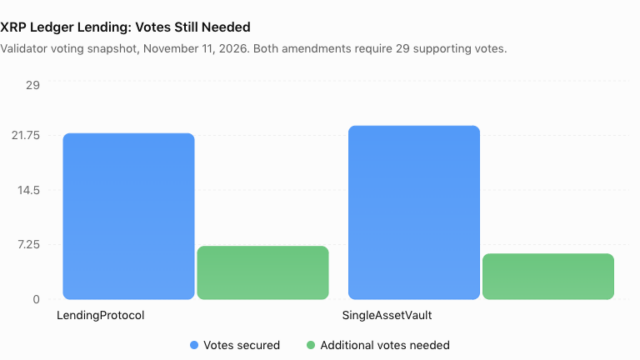
Source: XRP Ledger amendment tracker, November 11, 2026. Reaching 29 votes begins the required 14-day majority period; it does not guarantee immediate activation.
We believe the growing validator support is worth watching because it reflects continued development of the XRP Ledger’s institutional infrastructure.
Although approval is not guaranteed, the proposed lending system could become another important component of the network’s long-term growth strategy.
This story was originally published by Bitcoinist. Read the original article.