Stock Perpetuals Explained: How Funding, Margin and No Expiry Work
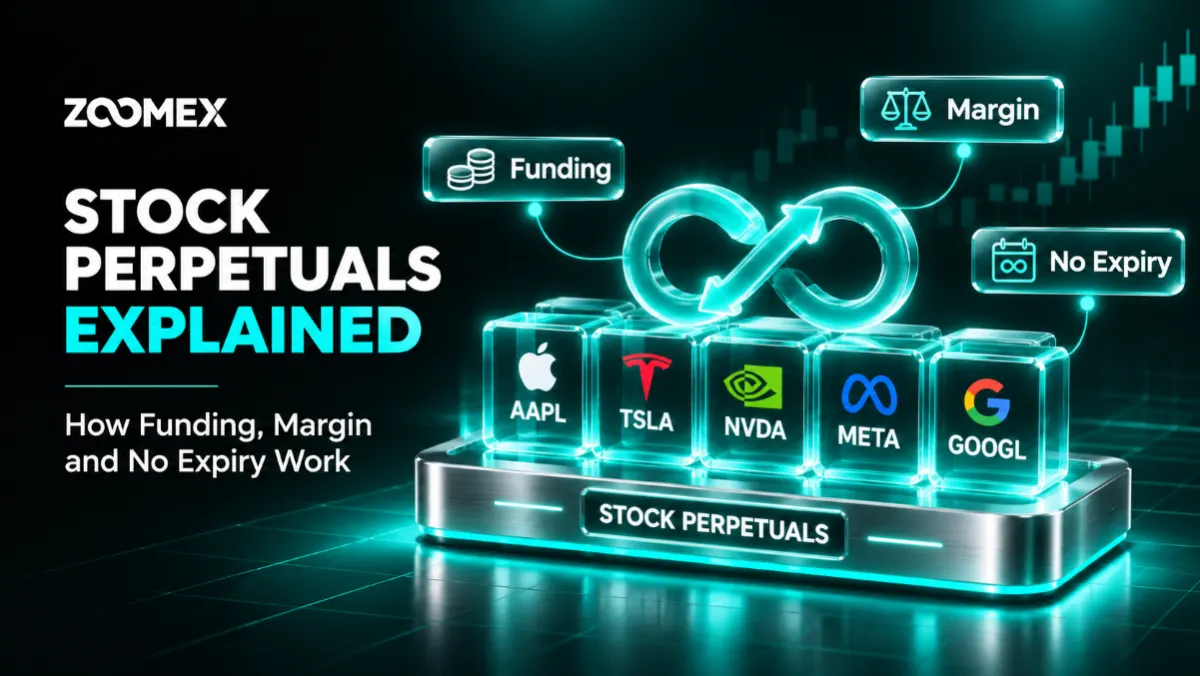
Perpetual futures on individual stocks are now at the centre of a regulatory dispute in the United States. On Zoomex, traders outside the U.S. can already use them in the TradFi Zone, with funding, margin and contract rules published on each contract page.
Zoomex’s Stock Perpetuals lineup in the TradFi Zone has grown past 50 contracts, and it now includes six ETF-linked perpetuals: SPYUSDT, QQQUSDT, IWMUSDT, XLFUSDT, XLKUSDT and TQQQUSDT. Traders can find them under the Stock category in Perpetual Trading, alongside Commodity Contracts and Stock Tokens in the same Unified Trading Account.
Every Stock Perpetual runs on the same matching engine and infrastructure as Zoomex’s USDT perpetuals. There is no separate account or new onboarding flow, which keeps the experience clear: the same order panel, the same account view and the same rules, whether the contract tracks Bitcoin or a listed equity.
The product category is also in the regulatory spotlight. On November 3, 2026, CFTC Chairman Michael Selig said in an official statement that perpetual futures on individual stocks can begin trading on registered U.S. exchanges. A group including Cboe and Citadel Securities has challenged the move in court, arguing the contracts fall under SEC jurisdiction, and the case is still being heard. The dispute turns on what a stock perpetual actually is, so this guide explains how the contracts work on Zoomex.
Why stock perps are suddenly everywhere
A stock perpetual is a derivative that tracks the price of a listed equity. It has no expiry date, so a trader can hold a long or short position for an hour or a month. It does not give ownership of shares, voting rights or any claim on the company. On Zoomex, contracts such as Apple (AAPL), Tesla (TSLA), Nvidia (NVDA), Meta (META) and Alphabet (GOOGL) are margined and settled in USDT, and are found under the Stock category in Perpetual Trading.
Because there is no expiry, there is no rolling from one contract month to the next. Something else has to keep the contract price close to the stock price, and that is the funding rate.
Funding: How it works
At fixed intervals, one side of the market pays the other. When the perpetual trades above the reference price, the funding rate is positive and longs pay shorts. When it trades below, the rate is negative and shorts pay longs. Zoomex calculates the payment on position value at each funding time:
Funding fee = Position value × Funding rate
Zoomex funds three times a day, every 8 hours, and each contract has a funding rate ceiling that is published in advance.
Practical example. A trader opens a long with 1,000 USDT of margin at 5x leverage, which is a position value of 5,000 USDT. If the funding rate at a given time is 0.01%, the long pays 0.50 USDT to shorts. With three funding times per day and an unchanged rate, that is about 1.50 USDT per day, or roughly 10.50 USDT over a week. If the rate turns negative, the same long would receive the payment instead. Funding is small on a single day, but it adds up on positions held for weeks, so check the current rate and schedule on the contract page before you open.
Margin: How leverage is managed
A trader posts USDT as margin and controls a larger position. Four settings and rules shape the risk:
Cross or isolated margin. Under cross margin, the whole balance of the Unified Trading Account supports the position, which lowers the chance of liquidation but exposes more of the account. Under isolated margin, the loss on one position is limited to the margin assigned to it.
Leverage cap. Each contract has its own maximum leverage, and Zoomex notes that leverage, tick size and funding rate caps can change with market conditions. Check the latest specification before opening a position.
Maintenance margin. Every position must keep a minimum level of equity. If losses take the account below it, the position is reduced or closed through liquidation.
Tiered requirements and deviation limits. Larger positions face higher margin requirements, and deviation limits are designed to prevent flash liquidations caused by brief price distortions.
Practical example. In isolated margin, a trader goes long at an entry price of 200 USDT with 5x leverage, so the initial margin rate is 20%. Zoomex’s published formula for a USDT long in isolated mode is:
Liquidation price = Entry price × (1 − Initial margin rate + Maintenance margin rate)
If the maintenance margin rate were 0.5%, the liquidation price would be 200 × (1 − 0.20 + 0.005) = 161 USDT, about 19.5% below entry. At 10x, the initial margin rate is 10% and the same calculation gives 190 USDT, only 5% below entry. Higher leverage means a much smaller move is enough to trigger liquidation. The actual maintenance margin rate differs by contract and position size, so use the figures on the contract page.
What happens when the stock market is closed
Stocks trade a limited number of hours each week, but a Zoomex Stock Perpetual trades 24/7. A trader can react to news that lands on a Saturday, for example, instead of waiting for Monday’s opening bell. While the underlying market is closed, the contract is priced against the last available reference and the platform’s own rules, so read the pricing and mark price information on the contract page before trading outside market hours. Stock Perpetuals run on the same matching engine as Zoomex’s USDT perpetuals, with the same execution logic at any hour.
Perpetuals or Stock Tokens
Traders who want exposure without leverage or funding payments can use Stock Tokens, which track major equities on a spot basis. Stock Contracts are the perpetuals described above. Both sit in the TradFi Zone alongside indices, ETFs, gold and crude oil, within the same account.
Official rules and where to find them
Zoomex publishes the rules that govern these contracts, and they are the final reference for any number in this article:
- Contract specifications for each Stock Perpetual: leverage cap, tick size, funding rate ceiling and margin requirements.
- Funding rate history and schedule.
- Fee schedule.
- Liquidation and margin rules.
What the U.S. decision means for traders elsewhere
The CFTC approval does not change what is available on Zoomex, and availability still varies by local regulation. For traders, the practical takeaway is the same whatever the court decides: understand how funding accrues, how leverage moves your liquidation price, and what the contract page says before you open a position.
About Zoomex
Founded in 2021, Zoomex is a global cryptocurrency trading platform focused on derivatives trading, serving over 3 million registered users across 35+ countries and regions and offering 700+ trading pairs. It also offers spot trading, TradFi contracts, Prediction Markets, Copy Trading, and tools including Zoomex AI, Strategy Center, and Grid Trading.
Guided by Clear · Transparent · Fair, Zoomex combines intuitive interfaces, transparent account and trading information, and consistent execution under clearly defined rules.
Zoomex has completed security audits by Hacken and maintains MSB registrations in the U.S. and Canada, NFA registration in the U.S., and AUSTRAC registration in Australia. Its public disclosures cover reserves, security, compliance, fees, and trading rules.
Zoomex is the Official Crypto Exchange Partner of TGR Haas F1 Team and has collaborated with professional tennis players competing at Wimbledon.
At Zoomex: Clear to Use. Transparent balance. Fair access to your earnings.
This story was originally published by BeInCrypto. Read the original article.