UK tribunal forces government to confirm secret Apple encryption order
On November 19, the Investigatory Powers Tribunal of the United Kingdom confirmed that the government had secretly contacted Apple, asking for access to encrypted customer information.
The revelation highlights the dilemma being faced by Apple. Encryption is important in building customer confidence, but government requests for access would jeopardize the safety promised by the company.
The ruling is about secrecy, not legality
The tribunal’s judgment rejected the British government’s attempt to keep the order secret. Officials had already acknowledged its existence to journalists and US authorities. That weakened the government’s claim that confirming the order would threaten national security.
The court has not made a decision about the legality of the order.
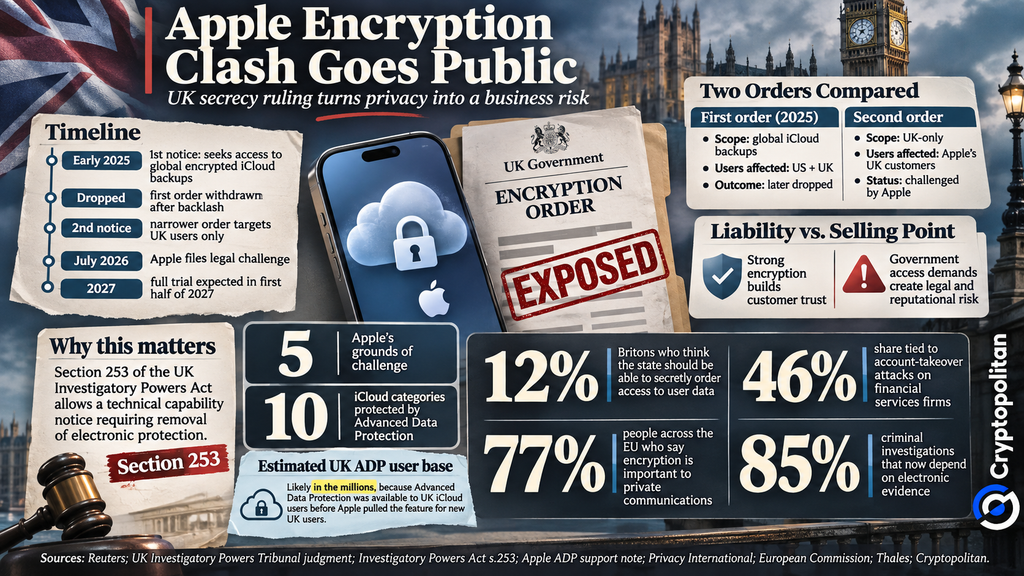
According to Section 253 of the Investigatory Powers Act, the government has the right to require operators to keep technical capabilities. This may involve the removal of electronic protections from data.
Apple has objected to the order on five different points, questioning the government’s authority to make such decision as well as the consultation process, human rights issue and discrimination against certain operators. The entire contents of the order remain confidential.
Two orders, two very different demands
Britain’s first notice, issued in early 2025, reportedly sought access to encrypted iCloud backups belonging to users worldwide, including Americans and Britons.
Following US opposition, the demand was dropped in August 2025.
A second notice reportedly followed in September, this time targeting UK customers only. Apple challenged it in July 2026.
The distinction is important. An order from the UK might eliminate certain challenges that arise internationally. However, it makes it more difficult for Apple to uphold its uniform level of security across the globe.
Apple’s Advanced Data Protection now allows full end-to-end encryption for ten more categories under iCloud, which equals to 40% of the total of 25 categories that Apple has recognized. However, users from the UK do not have the option to activate the service anymore.
Encryption as both a liability and a selling point
The dispute could influence how customers choose cloud services, especially as concerns about privacy and security grow.
British polling found that only 12% support secret government orders requiring companies to hand over customer information. Meanwhile, EU research found that 77% consider encryption important for private communications.
Cyberattacks make data protection even more important. Thales reported that financial services accounted for 46% of account-takeover attacks.
For cloud providers, strong encryption can help attract customers. But government demands for access could put that advantage at risk, particularly if customers begin questioning how secure their data really is.
A cross-border compliance problem
For global cloud providers, complying with one country’s data access rules could create problems in another.
The European Commission’s 2025 roadmap found that roughly 85% of criminal investigations depend on electronic evidence. Governments want access to that information, but different national laws make compliance increasingly complicated.
Britain argues that privacy “should not come at the expense of public safety,” according to Reuters.
Privacy advocates see the issue differently. Liberty director Akiko Hart called the ruling “a victory for transparency.”
The substantive hearing is expected in the first half of 2027. The outcome could help determine how far governments can go in demanding access to encrypted data, and what that means for cloud providers operating worldwide.
This story was originally published by Cryptopolitan. Read the original article.